
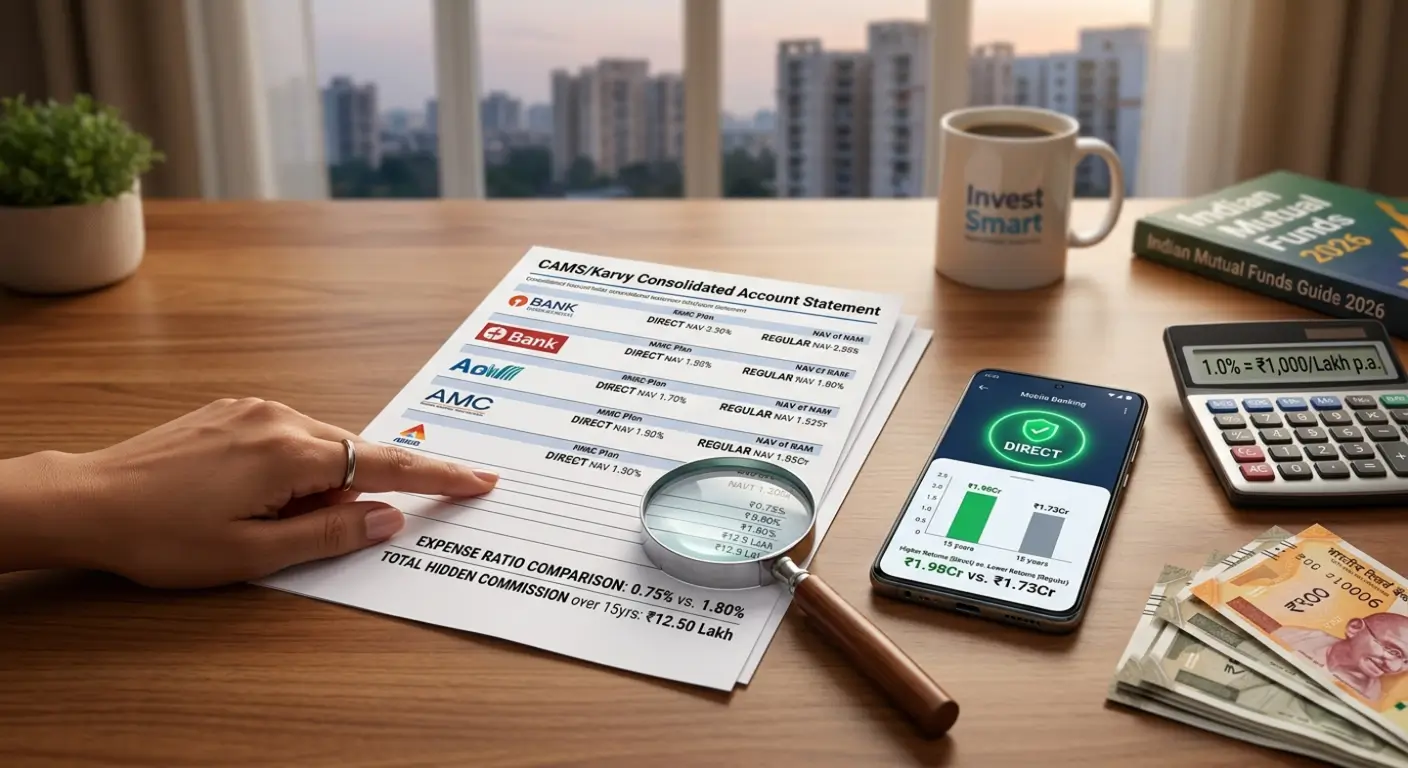
If you have been investing in mutual funds through a local bank agent or a family friend who “handles” your portfolio, you might feel everything is going great. Your money is growing, and the market is up. But there is a silent leak in your bucket that most Indian investors don’t notice for years. This leak is called the distributor commission. A small portion of your wealth is being diverted away from your investment and into the pocket of an intermediary.
Many people think that “regular” plans are free because they don’t pay a separate fee to their agent. This is a huge misunderstanding. The commission is already baked into the product. It is hidden inside something called the “Expense Ratio.” Over a decade, this tiny difference can grow into a mountain of money that could have paid for your child’s higher education or a luxury car. In this article, we will pull back the curtain on these hidden costs and see if the convenience of a regular plan is actually worth the price.
Table of Contents
What exactly is the “Direct” and “Regular” plan?
Every mutual fund scheme in India has two versions. The first is the Regular Plan. This is what you get when you buy through an agent, a broker, or a bank. The second is the Direct Plan. This is what you get when you buy directly from the AMC website or through a direct-only investment platform. Both plans are managed by the same mutual fund manager and invest in the same stocks. The only difference is the cost.
The Asset Management Company (AMC) pays a commission to the agent for “bringing” them a customer in a regular plan. Since the AMC doesn’t want to lose its own profit, it passes this cost to you by increasing the expense ratio. There is no agent, so no commission in a direct plan. That saved money stays in your account and starts compounding. It might look like a small 1% difference today, but compounding makes it a giant gap over twenty years.
The hidden math of expense ratios in mutual funds
The expense ratio is the annual fee a mutual fund charges to manage your money. In 2026, the average expense ratio for an equity direct plan is around 0.50% to 0.80%. For a regular plan, it can be 1.50% to 2.20%. That difference of roughly 1% is the “hidden fee” you pay for using an intermediary.
You might think that 1% is nothing. But you must realize that this 1% is calculated on your entire portfolio value every year. It is not calculated on your profit. Even if the market goes down and you lose money, the agent still gets their commission based on your total remaining balance. This is why regular plans are so profitable for banks and distributors but can be a drag on your long-term wealth.
The Real Cost Comparison: Direct vs. Regular (Mutual Fund)
| Feature | Direct Plan | Regular Plan |
| Intermediary | None (Invest directly) | Agent / Broker / Bank |
| Commission | 0% | 0.5% to 1.5% annually |
| Expense Ratio | Lower | Higher |
| NAV | Higher (Always) | Lower |
| Returns | Higher (by 1% to 1.5%) | Lower |
| Ease of Use | Requires self-research | Agent does the paperwork |
How much are you losing in a Direct vs Regular Mutual Fund
Let’s look at a practical scenario for a typical Indian middle-class investor. Suppose you start a monthly SIP of ₹20,000 in an equity fund for 20 years. We will assume the market gives a 12% annual return on the direct plan. Because of the commission, the regular plan will effectively give you only 11% returns.
After 20 years, your direct plan investment would grow to approximately ₹1.98 Crore. In the regular plan, your investment would be worth roughly ₹1.73 Crore. You just paid ₹25 Lakh in commissions! Most people don’t realize that their “helpful” agent is costing them the price of a flat or a premium SUV over the long term. This is the “lazy tax” that many Indian investors pay without even knowing it.
Why do people still choose regular plans?
If direct plans are so much better, why are regular plans still popular in India? The answer is “hand-holding.” The world of mutual funds is scary for many new investors. They don’t know which fund to pick or how to complete the KYC process. An agent makes it easy. They come to your house or office and handle all the boring paperwork.
Some agents also provide valuable advice on asset allocation and portfolio rebalancing. If your agent is truly providing expert financial planning that keeps you disciplined during market crashes, then that 1% might be a fair fee. But if your “agent” is just a bank employee trying to hit their monthly target by selling you any random fund, then you are being overcharged for a very simple service.
- Lower NAV in Regular Plans: You should check the Net Asset Value (NAV) of both versions of the same fund. You will notice that the Direct plan always has a higher NAV. This is because fewer expenses are deducted from the Direct plan, allowing the value to grow faster every single day.
- The Conflict of Interest: You must be aware that agents often recommend mutual funds that pay them the highest commission rather than the funds that are best for you. Since Direct plans pay zero commission, they are “unbiased,” and you are solely responsible for your choices.
- Switching Costs and Taxes: You should know that moving from a Regular to a Direct plan is considered a “redemption” by the tax department. This means you might have to pay Capital Gains Tax if you switch. You must calculate if the tax hit today is worth the 1% saving over the next decade.
- Technology is the Great Leveler: Use modern Indian investment apps that offer Direct plans for free. These platforms provide a smooth interface and research tools that make the “paperwork” excuse of agents completely invalid in 2026.
- Service vs. Transaction: You must distinguish between a “distributor” and a “Registered Investment Advisor” (RIA). An RIA charges you a flat fee for advice but puts you in Direct plans. A distributor gives “free” advice but takes a cut from your regular plan every month.
A lower NAV in regular plans is a constant reminder of the money leaving your pocket. Over time, the gap between the Direct NAV and Regular NAV keeps widening because of the compounded effect of saved commissions. The conflict of interest is also a major problem in India. Bank Relationship Managers (RMs) are famous for “churning” portfolios. They make you sell one fund and buy another just so they can earn a fresh commission.
Understanding the switching costs is vital for existing investors. If you have been in a regular plan for five years, you cannot just jump to direct without checking your Exit Load and Capital Gains Tax. However, for most long-term investors, paying a one-time tax is much better than paying a 1.2% commission every year for the next twenty years. Technology has made the agent’s job almost obsolete. Today, you can finish your KYC via an OTP on your phone. Finally, choosing an RIA is the most professional way to manage wealth. You pay them for their brain, not for a transaction.
How to switch to the Direct Plan Mutual Fund immediately
If you have realized that you are on a regular plan, don’t panic. The first thing you should do is stop all your active SIPs in the regular plans. You don’t want to add more money to a high-cost scheme. Instead, start fresh SIPs in the “Direct” version of the same mutual fund. Most apps now have a “Switch to Direct” button that makes this process very easy.
Next, look at your existing balance. Check if your units have completed one year to avoid Short Term Capital Gains (STCG) tax. If they are older than a year, you can switch up to ₹1.25 Lakh of profit tax-free every financial year (as per the latest 2026 tax rules). This “gradual switching” is a smart way to move your wealth without giving a big chunk to the taxman.
Smart steps to stop your mutual fund commission leak
1. Generate your Consolidated Account Statement (CAS) immediately
The first thing you should do is get your CAS from CAMS or KFintech (formerly Karvy). This single document acts as a master list for all your holdings and clearly labels whether each fund is “Regular” or “Direct.” You might be surprised to find that even investments made through your “online” bank portal are actually regular plans that are quietly charging you commissions every month.
2. Calculate your “Annual Leak” in rupees
You should do a quick math check to see how much you are actually losing. Simply multiply your total portfolio value by 0.01 (representing a 1% commission). For example, if you have ₹50 Lakh in mutual funds, you are paying approximately ₹50,000 every single year in hidden commissions. You must ask yourself if your agent’s advice is truly worth paying ₹4,000 every month for the rest of your life.
3. Educate yourself on low-cost Index Funds
You don’t need to be a financial genius to pick a winning investment. In 2026, low-cost Index Funds have become one of the best ways for Indian investors to build long-term wealth with zero stress. Since these funds simply track the market, the “Direct” version is almost always the winner because it has the lowest possible expenses, leaving more profit in your bank account.
4. Switch to “Direct-Only” investment platforms
You must avoid old-school websites and bank portals that only show you regular plans because they want to earn that commission from your hard-earned money. Instead, you should move your portfolio to modern platforms that explicitly state they are “Direct-Only.” These platforms are designed to help you save that 1% to 1.5% commission, which can add up to lakhs of rupees over your investment journey.
Conclusion
It is not really a battle between Direct and Regular mutual funds but actually doing it yourself or having someone do it. In the initial years of your career when your portfolio is small, the commission would be pocket change. However, when your wealth increases to 50 Lakh or 1 Crore then that 1% commission is a huge liability. To the majority of the Indian investors, the only easiest way of boosting their retirement corpus by 15 to 20 percent without incurring any additional market risk is to switch to Direct plans. It is time to make a difference on whether you value your hard-earned money or not. Being a passive passenger is no longer an option, it is time to be the driver of your own financial life. Saving 25 Lakh today may be the freedom that you will have tomorrow.
Read More: SIP Investment Tips to Maximize Returns in Volatile Markets