
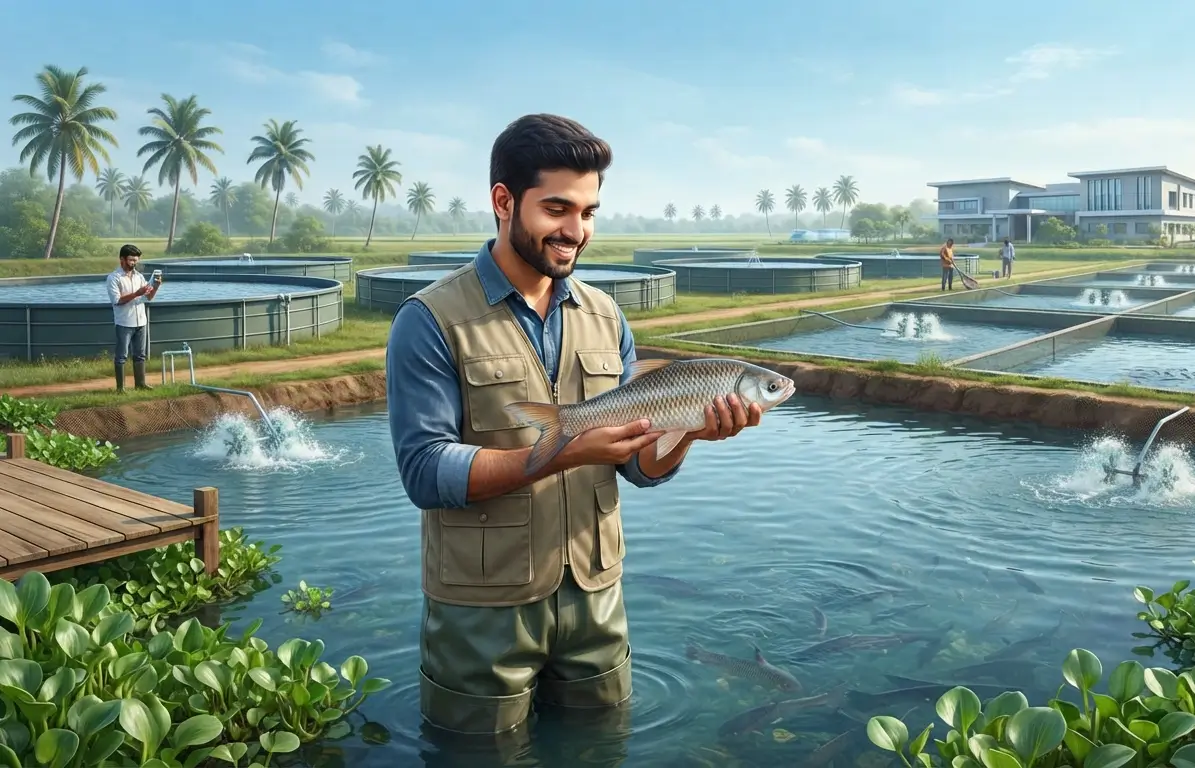
Fish farming is no longer limited to people who own a pond or come from a farming family. Today, pisciculture has become part of a much wider industry that includes aquaculture, fish seed production, feed, fish health, technology, processing, transportation, research, and marketing.
This creates different career opportunities in pisciculture for students, graduates, farmers, and people interested in starting their own business. India has a large fisheries research and education network. The ICAR coordinates research and education in fisheries and aquaculture through institutions such as the Central Institute of Fisheries Education, Central Institute of Freshwater Aquaculture, Central Inland Fisheries Research Institute, and others.
Why Consider a Career in Pisciculture?
One important reason to consider pisciculture is that it offers several different career paths. A student interested in pisciculture science may choose research or fish health. Someone interested in practical farm work may manage an aquaculture farm. A business-minded person may start a hatchery, fish farm, feed business, or fish retail operation. Technology is also becoming more important for pisciculture. Modern aquaculture can involve water-quality monitoring, aeration equipment, automatic feeding, biofloc systems, and recirculating systems.
The government and ICAR also continue to support research, training, and development activities in fisheries and aquaculture. ICAR’s fisheries division describes fisheries as an important production sector that contributes to food, nutrition, livelihoods, exports, and related industries. This means the career is not limited to traditional pond farming.
What Are the Main Areas of Pisciculture?
Before choosing a career, it helps to understand the different areas within the sector.
1. Fish Farming
This is the most familiar part of pisciculture. Farmers raise fish in ponds, tanks, or other systems and sell them after they reach marketable size. The work involves pond preparation, stocking, feeding, water management, disease prevention, harvesting, and marketing.
2. Fish Seed Production
Fish farmers need healthy seed or fingerlings. Hatcheries produce and supply fish seed to farms. This creates opportunities for people who understand breeding, hatchery management, and fish health.
3. Fish Feed
Feed is an important part of aquaculture. Companies manufacture and sell feeds designed for different fish species and growth stages. This creates opportunities in production, quality control, sales, distribution and technical support.
4. Fish Health
Fish can suffer from diseases and other health problems. Professionals trained in aquatic animal health can work in farms, laboratories, research institutions and related organisations.
5. Aquaculture Technology
Technology is increasingly being used to control water quality, feeding, aeration and production conditions. People with knowledge of aquaculture and technology can work with equipment suppliers, farms and research projects.
6. Fish Processing
The career does not end when fish are harvested. Cleaning, chilling, storage, packaging, processing and transportation are important parts of the supply chain. This creates opportunities outside the farm itself.
Which Course Should You Study for Pisciculture?
For students who want to build a professional career in pisciculture, one of the main undergraduate options is the Bachelor of Fisheries Science (B.F.Sc.). The programme provides education in different areas of fisheries and aquaculture.
Subjects can cover areas such as:
- Aquaculture
- Fish biology
- Fish breeding
- Fish nutrition
- Aquatic animal health
- Fisheries resource management
- Fisheries extension
- Fish processing
- Farm management
The exact curriculum depends on the university. For students interested in advanced study, postgraduate programmes such as M.F.Sc. can provide opportunities to specialise further. ICAR’s current fellowship information lists postgraduate areas including Fisheries Resource Management and Aquaculture at ICAR-CIFE.
B.F.Sc. Eligibility
Eligibility for a B.F.Sc. programme depends on the university and admission route. Students who have completed Class 12 with the required science subjects can apply to fisheries science programmes where they meet the university’s conditions. However, students should not depend on a general eligibility rule found on an old website. Admission requirements, entrance examinations, subject combinations, and admission routes can change. Before applyi ng, check the latest admission notification issued by the university or relevant counselling authority.
What Can You Study After B.F.Sc.?
A B.F.Sc. degree can be followed by postgraduate education in specialised areas.
Possible areas include:
- Aquaculture: This focuses on breeding and raising aquatic organisms under controlled conditions.
- Fish Genetics and Breeding: This area deals with improving fish stocks and understanding genetic characteristics.
- Fish Health: Students can specialise in diseases, diagnosis, prevention, and aquatic animal health.
- Fisheries Resource Management: This focuses on the management and conservation of fisheries resources.
- Fish Processing Technology: This area deals with processing, preservation, quality, and value addition.
- Fisheries Extension: Extension professionals help transfer useful technical information to fish farmers and communities.
- Fisheries Biotechnology: This combines fisheries with laboratory and biological techniques.
The availability of these specialisations depends on the institution and programme.
Career Opportunities After Pisciculture
A fisheries degree can lead to different types of employment.
1. Fisheries Officer
Government fisheries departments recruit professionals for different positions depending on their recruitment rules. Work can include farmer support, field activities, fisheries development programmes, inspections, and implementation of government initiatives. The exact qualifications and selection process depend on the particular vacancy.
2. Aquaculture Farm Manager
A farm manager may supervise day-to-day fish production. Responsibilities can include feeding, stocking, water management, worker supervision, disease monitoring, and harvest planning.
3. Hatchery Manager
Hatcheries require people who understand fish breeding and seed production. A hatchery manager may supervise breeding, nursery operations, water conditions, fish health, and seed quality.
4. Fisheries Researcher
Students interested in science can move into research. Research opportunities exist in areas such as aquaculture, breeding, nutrition, fish health, genetics, fisheries resources and technology. ICAR operates several fisheries research institutes across these areas.
5. Fish Health Professional
Fish health professionals can work with farms, laboratories, research organisations and aquaculture companies. Their work can involve disease diagnosis, prevention, and health management.
6. Fisheries Extension Professional
Extension work involves helping farmers understand better production methods. Good communication skills are important because technical information often needs to be explained in simple language.
7. Fish Processing Professional
Food processing companies require professionals who understand handling, quality, preservation, packaging, and processing.
8. Aquaculture Sales and Technical Support
Feed, equipment, seed, and aquaculture technology companies need people who understand both the products and the problems faced by fish farmers.
Government Jobs in Pisciculture
Government employment is one of the career paths available to pisciculture graduates. Depending on the vacancy and qualification requirements, opportunities can arise in:
- State fisheries departments
- Central government organisations
- ICAR institutes
- Agricultural universities
- Research projects
- Fisheries development programmes
- Extension programmes
- Government-supported fisheries projects
ICAR lists the Central Institute of Fisheries Education as a fisheries science deemed university and also operates several specialised fisheries research institutes. However, there is no single government job available to every B.F.Sc. graduate.
Each recruitment notification specifies its own educational qualifications, experience, age requirements, and selection process. Therefore, students should always read the official recruitment notification before applying.
Private Sector Jobs in Pisciculture
Private companies also provide opportunities. A fisheries graduate may find work with:
- Fish farms
- Hatcheries
- Aquaculture companies
- Fish-feed manufacturers
- Seed suppliers
- Fisheries equipment companies
- Seafood processing companies
- Cold-chain businesses
- Fish retailers
- Aquaculture technology companies
- Consulting and development organisations
Some jobs are field-based while others involve laboratories, sales, management, processing or technical support.
Can You Start a Fish Farming Business?
A fisheries qualification can also be useful for entrepreneurship, although a degree is not always required to start a fish farm. Possible business ideas include:
a. Fish Farming: You can raise suitable fish species in ponds or tanks and sell them to local buyers.
b. Fish Hatchery: A hatchery produces fish seed for farmers. This requires more technical knowledge than ordinary grow-out farming.
c. Fish Feed Business: Farmers regularly need quality feed. A business can focus on manufacturing, distribution, or retailing depending on the scale and local market.
d. Ornamental Fish Business: Ornamental fish can be sold to aquarium owners, shops, and other buyers.
e. Fish Retail Business: Buying fish from producers and selling them in local markets is another business model.
f. Fish Processing: Cleaning, cutting, packaging, chilling, and other value-added activities can create opportunities close to consumer markets.
g. Fish Transport: Fish is a perishable product, so proper handling and timely transportation are important.
How Much Does a Fish Farmer Earn?
There is no fixed salary for pisciculture because fish farming is a business rather than a standard salaried job.
Income can change based on:
- Pond size
- Fish species
- Stocking density
- Survival rate
- Feed cost
- Seed cost
- Labour cost
- Water availability
- Disease losses
- Production level
- Local fish prices
- Transportation expenses
- Market access
A farmer may produce a large quantity of fish but still have lower profits if feed, labour or transportation costs are high. This is why people planning a fish-farming business should calculate total cost and expected selling price rather than relying on a fixed income figure.
Government Support for Fisheries
Government schemes can support different parts of the fisheries sector. The target article notes current support through programmes including the PMMSY and the Pradhan Mantri Matsya Kisan Samridhi Sah-Yojana (PM-MKSSY). It also notes that eligible fisheries participants can access the Kisan Credit Card facility for working-capital needs.
The important point is that support depends on the specific scheme component, applicant category, and applicable rules. Anyone planning to invest should check the latest information with the relevant fisheries department, implementing agency, or bank before spending money.
Skills Needed for a Career in Pisciculture
A successful career requires more than a pisciculture degree.
- Fish Biology: You should understand how different fish species grow and behave.
- Water Management: Water quality has a major effect on fish growth and survival.
- Disease Awareness: You should know how to identify warning signs and follow appropriate prevention and treatment practices.
- Farm Management: Basic knowledge of stocking, feeding, labour and production records is useful.
- Communication: Fisheries professionals often work with farmers, workers, customers and businesses.
- Record Keeping: A simple record of feed, seed, mortality, growth, expenses and sales can help a farmer understand whether the operation is actually profitable.
- Business Skills: Entrepreneurs need to understand costs, buyers, pricing, transportation and market demand.
Final Thoughts
A career in pisciculture is much broader than simply raising fish in a pond. Students can study fisheries science and move into aquaculture, fish health, hatcheries, research, processing, extension, government services, or private companies.
Those interested in business can explore fish farming, hatcheries, feed, ornamental fish, processing, transportation, and other parts of the fisheries value chain. The right path depends on your education, interests, available resources, and career goals. If you are considering fisheries as a profession, start by researching recognised fisheries programmes, checking the latest admission requirements, and gaining practical exposure. For business plans, study your local water resources, fish species, input costs, and market before investing. Pisciculture combines science, farming, technology and business, making it a field with career opportunities well beyond the traditional image of a fish farmer.