
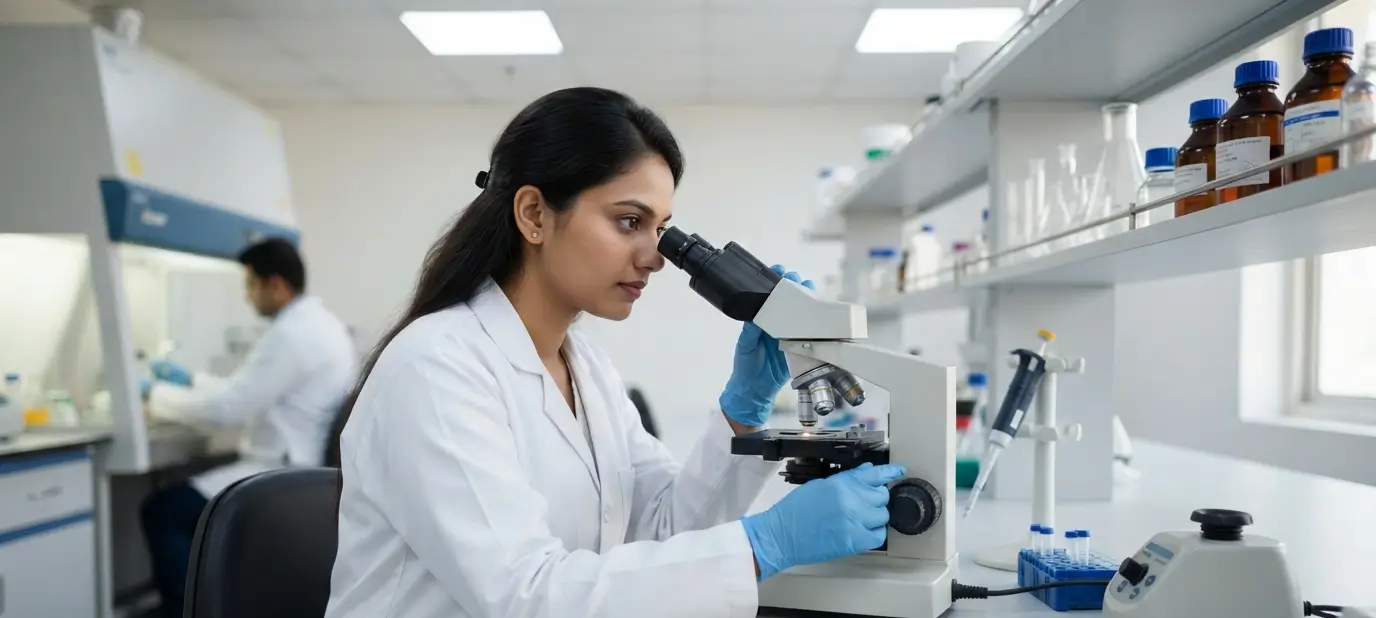
Microbiology is the study of microorganisms that are too small to be seen with the naked eye. These include bacteria, fungi, protozoa, algae, and other microscopic organisms. Microbiology may first appear to be a subject connected mainly with diseases and hospitals. But the field is much wider.
Microbiologists can work in hospitals, diagnostic laboratories, pharmaceutical companies, biotechnology, food processing, agriculture, environmental testing, research institutes, and educational institutions. The ICMR has job openings for microbiology and life science experts across its research centers. These jobs are available for both medical and non-medical professionals.
Why Choose Microbiology as a Career?
Microbiology can be suitable for students who enjoy biology but also like laboratory work and scientific investigation. The subject requires patience because laboratory experiments often involve careful preparation, observation, and documentation. A microbiology student may learn how to culture microorganisms, observe samples, perform laboratory tests, maintain sterile conditions, and interpret results.
The field also offers opportunities beyond hospitals. The UGC maintains a model curriculum framework for microbiology at undergraduate and postgraduate levels, showing that microbiology is established as an academic discipline within Indian higher education.
Microbiology Courses After Class 12
Students interested in microbiology can consider an undergraduate degree after completing Class 12. One common route is:
1. B.Sc. Microbiology
A Bachelor of Science in Microbiology introduces students to microorganisms and laboratory science. Depending on the university, subjects can include areas such as:
- General microbiology
- Cell biology
- Biochemistry
- Molecular biology
- Genetics
- Immunology
- Microbial physiology
The exact curriculum varies between universities. Students should therefore compare the syllabus, laboratory facilities, practical training, and admission requirements before selecting a college.
What Eligibility Is Needed for B.Sc. Microbiology?
Eligibility varies between universities. Generally, students who have completed Class 12 with science subjects can explore B.Sc. Microbiology programmes. Biology and chemistry are particularly useful for understanding the subject. University admission guidelines change frequently, and staying updated with official notifications ensures students don’t miss any critical changes regarding eligibility or deadlines.
The University Grants Commission’s undergraduate framework also supports flexible, multidisciplinary higher education pathways under the current academic framework.
What Can You Study After B.Sc. Microbiology?
A bachelor’s degree can be followed by postgraduate education.
1. M.Sc. Microbiology
An M.Sc. can provide deeper knowledge of microbiology and may include advanced laboratory work and research.
2. Medical Microbiology
This area focuses on microorganisms associated with human diseases and laboratory diagnosis.
3. Industrial Microbiology
Industrial microbiology looks at the use of microorganisms in industrial processes.
4. Food Microbiology
This focuses on microorganisms in food, contamination, preservation, fermentation, and food safety.
5. Environmental Microbiology
Environmental microbiology studies microorganisms in soil, water, and other environmental systems.
6. Molecular Biology
This area focuses on biological processes at the molecular level and overlaps with microbiology, genetics, and biotechnology.
7. Biotechnology
Students can also move toward biotechnology, where microbiology can be combined with molecular biology, genetics, bioprocessing and other technologies.
Career Options After Microbiology
A microbiology degree can lead to different types of jobs. The actual opportunities available to a graduate depend on qualification, practical experience, specialisation and the employer.
1. Microbiologist
Microbiologists may work in laboratories where they study and identify microorganisms. Their work can involve sample preparation, testing, documentation and analysis. The exact duties depend on the industry.
2. Medical Microbiology
Medical microbiology is connected with the diagnosis and study of infectious diseases. However, students should understand that some clinical microbiology positions have specific professional qualification requirements. Therefore, a B.Sc. Microbiology graduate should not assume that every hospital microbiology position is open to them. Always check the qualifications listed in the job advertisement.
3. Pharmaceutical Industry
Pharmaceutical companies need microbiological testing in different parts of production and quality systems. Depending on the organisation, microbiology professionals may work in areas such as:
- Quality control
- Environmental monitoring
- Sterility testing
- Contamination control
- Laboratory testing
- Research and development
4. Biotechnology
Biotechnology companies use biological systems to develop products and processes. Microbiology graduates can find opportunities in laboratory work, research assistance, quality functions, and production depending on their qualification.
India’s biotechnology ecosystem also includes research institutions, startups, and incubation programmes. The BIRAC, for example, supports biotechnology entrepreneurship and innovation through programmes and incubators.
5. Food Microbiology
Food companies need to maintain hygiene and control microbial contamination. Food microbiologists can work on:
- Food safety
- Microbial testing
- Quality control
- Shelf-life studies
- Hygiene monitoring
- Laboratory analysis
This can be a useful career area for students interested in both biology and the food industry.
6. Environmental Microbiology
Microbiology also has applications in environmental testing. Professionals can work with laboratories and organisations involved in water testing, wastewater treatment, soil studies and environmental monitoring. This field demonstrates that microbiology is not limited to hospitals.
7. Agricultural Microbiology
Microorganisms play an important role in soil and agriculture. Some microorganisms interact with plants and soil and can be studied for applications in agriculture. Students interested in farming, soil science and biotechnology can therefore consider agricultural microbiology as a specialisation.
8. Research Assistant
Research institutes regularly conduct projects in microbiology, biotechnology, infectious diseases and other life-science areas. Entry-level research positions may require a bachelor’s or master’s degree depending on the post. ICMR’s recruitment portal shows that its institutes regularly advertise temporary project positions as well as other employment opportunities.
9. Laboratory Technician
Some laboratory positions are open to candidates with science degrees or specialised laboratory training. The exact qualification depends on the employer. A strong understanding of laboratory procedures, safety and documentation can be useful for these roles.
10. Teaching and Academia
Students interested in education can pursue postgraduate and doctoral qualifications and later explore teaching or academic research. Higher-level academic positions generally require advanced qualifications and other eligibility requirements.
Government Jobs After Microbiology
Government and publicly funded research institutions provide another career route. Potential areas include:
- Medical research
- Public health laboratories
- Research institutes
- Universities
- Food testing
- Environmental laboratories
- Agricultural research
- Biotechnology research
- Scientific projects
ICMR is one example of a major government research organisation where microbiology-related positions appear in recruitment notices. Recent ICMR advertisements have included positions requiring master’s degrees in life sciences and related subjects for certain non-medical research roles, while medical microbiology positions can require medical qualifications such as MD/MS/DNB depending on the post.
Private Sector Jobs in Microbiology
The private sector offers opportunities across several industries.
- Pharmaceutical companies
- Biotechnology companies
- Food manufacturers
- Diagnostic laboratories
- Hospitals
- Research laboratories
- Water-testing laboratories
- Environmental companies
- Agricultural biotechnology businesses
- Personal-care and cosmetic manufacturers
- Testing and quality-control laboratories
One organisation may hire a candidate as a microbiologist, while another may use titles such as quality-control executive, laboratory analyst, research assistant, or technical associate.
What Skills Does a Microbiologist Need?
A degree provides the foundation, but practical skills are extremely important in laboratory careers.
- Laboratory Skills: Students should get comfortable with basic lab tools and tasks. Getting hands-on practice helps connect what they learn in class to real-world work.
- Sterile Techniques: Maintaining clean and controlled laboratory conditions is important when working with microorganisms.
- Observation: Small changes in a sample or culture can be important. Careful observation is therefore a useful skill.
- Documentation: Laboratory work requires accurate records. A student should develop the habit of recording procedures, observations and results carefully.
- Basic Computer Skills: Modern laboratories use computers for documentation, data analysis and reporting.
- Communication: Microbiology professionals may need to explain results to colleagues, managers, clients, or other professionals.
- Problem-Solving: Unexpected results can happen during laboratory work. The ability to investigate possible causes and follow a systematic process is useful.
Microbiology Salary in India
There is no single salary for microbiologists in India. Income depends on several factors, including:
- Educational qualification
- Work experience
- Job role
- Industry
- Location
- Employer
- Specialisation
- Laboratory skills
- Research experience
A fresh B.Sc. graduate may enter a different role and pay range than an experienced M.Sc. professional or a PhD-qualified researcher. Government research positions also follow the pay or consolidated-emolument structure specified in their individual recruitment notifications.
Can a Microbiologist Start a Business?
Yes, although the type of business depends on education, regulations, investment, and technical expertise. Possible areas include:
- Diagnostic or Testing Services: Qualified professionals may explore laboratory testing businesses where the required licences, registrations, and professional qualifications are met.
- Food Testing: Food manufacturers and businesses need testing and quality services.
- Biotechnology Startup: Entrepreneurs with advanced technical knowledge can explore biotechnology products and services.
- Microbial Products: Research and commercial development can involve products based on useful microorganisms, subject to applicable regulations and technical requirements.
- Laboratory Consultancy: Experienced professionals can provide specialised technical or quality-related services where permitted.
Final Thoughts
Microbiology is a broad life-science field with applications in healthcare, pharmaceuticals, biotechnology, food, agriculture, environment and research. A B.Sc. in Microbiology can provide an entry point into the field, while postgraduate education can help students develop deeper specialisation.
Career options may include laboratory work, quality control, research, food safety, pharmaceutical microbiology, biotechnology and environmental testing. Government research organisations such as ICMR also advertise microbiology and related life-science positions, although eligibility differs from one post to another.