
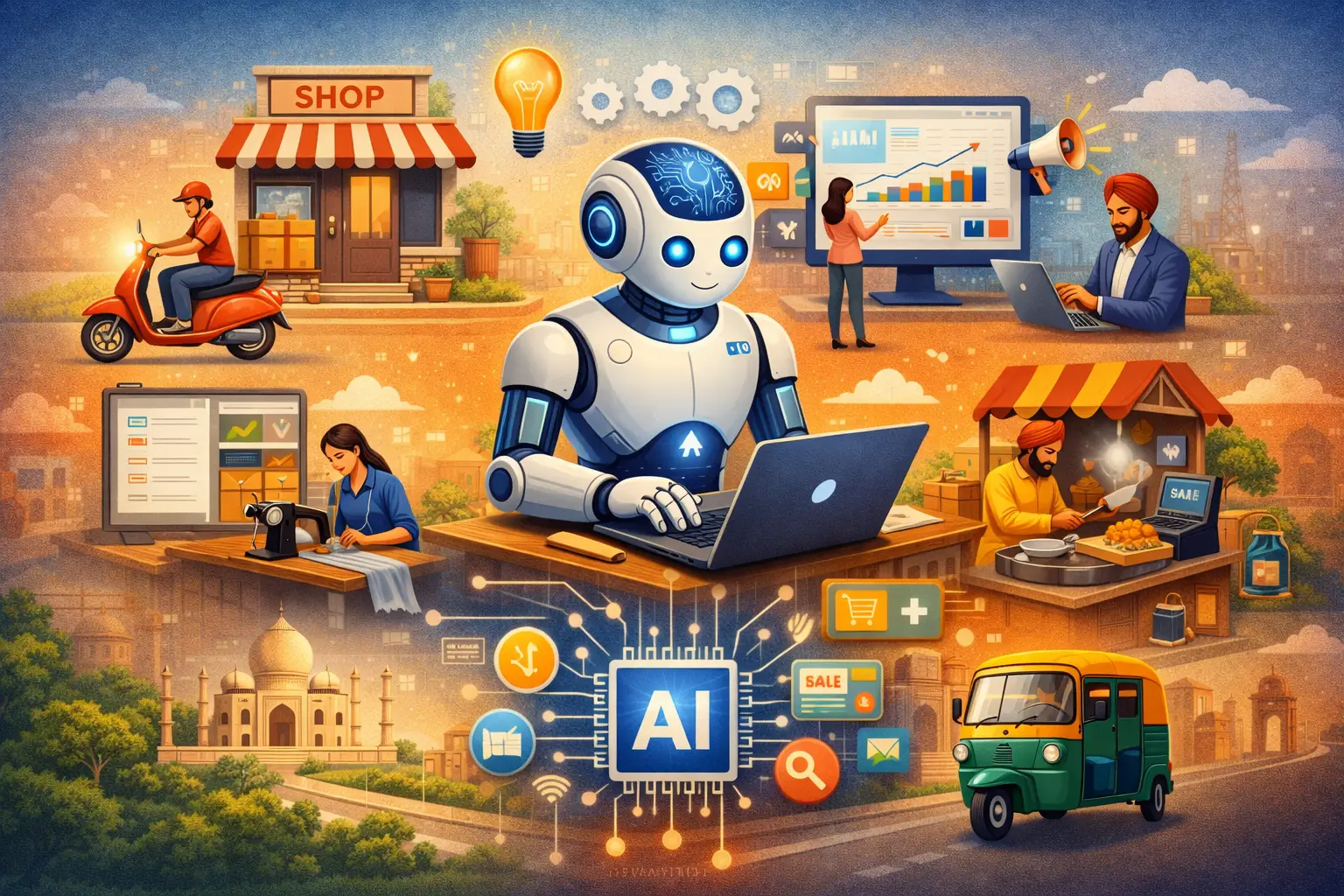
Suppose you are operating a small business today in India, such as a textile factory in Surat, a start-up in Bengaluru, or a retail chain in Indore. The question about the Artificial Intelligence that you are asking is likely to have been transformed.
In 2026, if you still thought that AI belongs solely to Google, Microsoft, or startups in the big cities. The playing ground has now become uneasy beneath the feet of large businesses, and the distance that they used to enjoy over small businesses is narrowing more rapidly than most individuals know.
IndiaAI Mission by the government has also subsidised computing power so that one can get 1 hour of computer power at 65 rupees, and there is also a new generation of models tailored to Indian languages and the Indian business environment. The entry barrier is actually low now.
This guide will transform your thinking using AI for Small Businesses. By the time you complete your reading, you will have an idea of what AI can fairly do to your business, which services are worth spending money on, and how to start without making the costly mistakes that most beginners have gone through.
Table of Contents
What Exactly Is AI for Small Businesses?
In the business scenario, AI is a type of software that learns based on patterns and then does the job that would otherwise be done by a human being. The more it gets at doing something, the better it gets at doing it.
As an ordinary business, this has nothing to do with substituting your employees. It is the process of substituting the monotonous and low-level jobs that consume your prime hours daily. The things that do not require your brain and simply require time. And time is all that AI for small businesses brings back to you.
For Example, one of the owners of the boutique in Jaipur spent three hours each evening manually responding to the messages received on the Instagram account and WhatsApp. She currently uses a chatbot on WhatsApp. When a customer inquires, the system calculates the product in question, sends the price, confirms that they are in stock, and sends a UPI payment link all automatically. She only intervenes when it is something that really requires a personal touch,
She did not hire a tech team. She wrote not a line of code. She found out her greatest time waste and located the appropriate tool and installed it in a weekend. That is what AI for Small Businesses means in India in 2026.
Vernacular Shift With AI for Small Businesses in India
AI is not the largest growth in Indian digital marketing at the moment. It is Vernacular AI – the capability of producing high-quality content in any of the regional languages (Hindi, Tamil, Telugu, Marathi, Punjabi, and other languages) immediately, without recruiting a translation agency.
The statistics of this are impressive. The increase in the regional language content has risen by 156% compared to the English content in Tier 2 and Tier 3 cities in the last year. Small businesses, which once took weeks and a considerable amount of money to localise their campaigns, are currently accomplishing it within minutes with models such as BharatGen and services offered by startups such as Sarvam AI.
Another puzzle that is worth listening to is voice search. The Indian internet population is today 65% voice searchers, and it does so in their native language. A company that has vernacular voice search optimised online presence is registering returns almost three and a half times as compared to one that does not.
Nowadays, a video message on WhatsApp can be delivered to a client in Pune in natural Marathi and an entirely different one to a buyer in Ludhiana in Punjabi in the same product, the same promotion, and really different communication, all created by the same tool in a few minutes.
If your marketing is still being done exclusively in the English language, you are still not capturing a significant portion of the Indian market at all. Using AI for small businesses is a very handy and smart move.
Why Indian Owners Need AI for Small Businesses
Running a small business in India is a very different challenge from running one almost anywhere else. Its owner is usually the person who puts on all the imaginable hats, like an accountant, a salesperson, a delivery coordinator, a social media manager, and a customer care executive, at the same time. By half-past six in the evening, the mental fatigue is actual, and it accumulates with every week.
AI is not a solution to all the problems. But it meaningfully reduces the weight in four specific areas.
1. Getting Actual Time Back
All those activities that repeat every single time, like an invoice prepared in GST format, scheduling a month of social media posts at a time, automatic payment reminders, and invoice follow-up. When you give them to an AI tool, you no longer think about them. The time you save is spent on your judgment decisions: which product line to distribute further, which market to enter next, and what supplier relationship to invest in.
2. Cutting Costs and Not Cutting Quality
A small business can spend between 60,000 INR to 100,000 INR a month hiring a full-time content writer, a graphic designer, and a customer support individual. It is possible to have simple versions of all of them with good AI tools under 5000 a month. You are not receiving the richness of a senior professional, but where high-volume tasks are involved, and routine work, the work is more than satisfactory.
3. Customer Satisfaction 24Hrs a Day
Indian customers are fast responders. When your competitor responds to a WhatsApp request within five minutes, and you take two hours, your competitor has disappeared. This issue is solved perfectly by AI-based automated responses and 24/7 service. Other devices have the memory of what a customer last purchased and suggest something to him/her next time he/she contacts the company.
4. Decision Making Based on Data
It is a question that most small business owners would not be able to answer correctly. What product are you selling best on Friday evenings? This can be done in seconds by the AI tools that relate to your sales records. They are also able to determine which products are gathering dust on the shelf, and when you need to order before it runs out. You no longer guess and begin to deal with real figures.
Agentic AI for Small Businesses Grow
Most small business owners who used AI in the last year were applying it as a very fast typist. You had asked a question, it had been answered, and you had copied it where you wanted it.
What has changed significantly in 2026 is the arrival of what practitioners call Agentic AI. A system that not only responds to your questions but actually performs multi-step jobs on your behalf within limits you establish.
Think of it this way. Instead of you asking AI to draft a vendor follow-up email, you set a rule: “If any invoice is unpaid after 15 days, identify it, draft a professional follow-up, and flag it for my review before sending.” he AI then scans your accounts, the overdue invoice, composes the message, and presents it in front of you, where it undergoes a final check. You approve it in thirty seconds. Done.
This type of workflow is now being applied to financial reconciliation, i.e., an AI agent links your bank account, your GST portal, and your Tally or Zoho books, and identifies discrepancies and presents any invoices that are not around without you manually having to compare three systems. Supplier discovery via the government MSME-TEAMS portal is also underway, where AI tools can assist small manufacturers find trustful raw material suppliers in real-time, based on ability and credit history rather than on word-of-mouth or former acquaintances.
The transitional phase between AI-as-assistant and AI-as-executor is here, and it is where the meaningful time savings are taking place.
Using AI for Small Businesses Can Solve Middle-Office Problem
Sales and marketing are the areas where everyone would love to discuss AI due to the visibility of its results and its excitement. However, it is the less glamorous aspects of your business, inventory, quality checks, and logistics that AI is saving the most money for Indian small businesses in 2026.
A small manufacturer, which used to lose two or three working days per month, solely to balance the inventory record, now regains the time. A logistics operator that used to make a loss by using a fixed route that was not efficient is now able to modify delivery routes in real time. These are AI stories that do not make the headlines, but they gain margins.
How to Start Using AI for Small Businesses
Step 1: Write Down What Drains Your Day
Be on a notepad for one full working day. Whenever you do something that you think you have done a hundred thousand times already, the same response, the same notification, the same form, write it down. At the close of the day, you will know the list of tasks that are ideal to be automated. The usual ones: payment reminders, replies to ” where is my order, product description, and weekly reports.
Step 2: Find the Right Tool for Your Problem
Do not become distracted by all the new apps that you see advertised. Select a tool that deals with your greatest frustration. Tally or Zoho are good places to start in case your accounts are in a mess, and you are feeling anxious about the GST season. Canva or ChatGPT are the places to start with, if your Instagram page is dead due to poor captions. Solve one real problem first. Solve it well. Then look at what is next.
Step 3: Start With Just One Task
On the first day, you do not automate your whole business. This is what makes people feel overwhelmed and leave everything in the past within two weeks. Begin with a single task, such as your customer newsletter each week, or the responses you provide on WhatsApp to the FAQs. Become familiar with the operations of the tool, observe actual results, and then build on it.
Step 4: Self-assess 30 days later
After one month, get down to business with oneself. What was the number of hours you saved? Did you receive fewer customer inquiries? Was the creation of content meaningfully increased? In case one tool was useful, retain it and find the next problem to solve.
Mistakes That Will Cost You Time and Money
A) Signing Up for Too Many Tools at Once
This is the pitfall that first-timers often fall into. You read a couple of articles in a week, subscribe to half a dozen apps and pay for three of them, and devote more time to changing the dashboards rather than to working. Choose two or three tools and learn to use them to the fullest extent before even beginning to contemplate a new one.
B) Giving Everything to AI and Walking Away
AI is able to write, schedule, and reply. But it is not able to perceive a situation like a human being. In case a client is actually angry, or an order with a supplier is becoming difficult, an electronic response will only exacerbate the situation. Remember to be in the loop in any discussion that may need real judgment, empathy, or managing relationships.
C) Sharing Sensitive Customer Data Carelessly
You do not have to be a technology-savvy person. However, you do have to invest an hour or two in actually learning how whatever tool you are paying for actually works. The quality of the output of AI is nearly entirely determined by the quality of the instructions you provide to AI. Clarity of instructions is productive. Indirect statements generate debris. The investment in learning is minimal, and the returns are short-term.
D) Skipping the Learning Phase
You do not need to become a tech expert. But you do need to spend an hour or two genuinely learning how any tool you are paying for actually works. The quality of what AI gives you depends almost entirely on the quality of the instructions you give it. Clear instructions produce useful results. Vague instructions produce garbage. The learning investment is small, and the payoff is immediate.
What Does Cost Using AI for Small Businesses?
This is where the majority of society presumed the worst, and they are mistaken.
When you are a beginner, your cost is zero. The free version of ChatGPT and WhatsApp Business combined provides actual functionality without spending even one rupee.
To have a more full-fledged business system, Canva Pro at approximately ₹400 per month, ChatGPT Plus at approximately 1600 per month, and an AI-assisted accounting tool, the cost is often in the range of 2500 to 5000 per month.
Divide that by an extra employee earning the minimum wage of 15,000 to 20,000 a month, and the answer is easy. You are not wasting money in a technology craze. You are reclaiming your time and your intellectual strength, and no price is higher than that.
Tools Using AI for Small Businesses in India (2026)
These platforms have been specifically designed with the Indian market in mind for those businesses who are willing to start today:
- Financial management and GST compliance — Kosh and Lendingkart AI can be used to provide visibility of real-time cash flows and tax compliance without the need to employ a full-time finance team.
- Manufacturing and quality control — Indian startups such as Detect Technologies are providing Edge AI sensors, which can be attached to existing machinery to identify when it is going to malfunction in order to prevent expensive downtimes.
- Customer engagement — Haptik and Yellow.ai provide both multilingual WhatsApp bots that reply to the common customer messages in Indian languages, with both bots averaging a 90 percent response rate without involving human intervention.
- Research and proposals — To analyze the market and to prepare a pitch with high stakes in the business, having a powerful research tool and an effective writing assistant would provide founders with a true advantage in terms of competitive offers.
Relevance of AI for Small Businesses, and IndiaAI Mission
India has already invested above 10,300 crore in the IndiaAI Mission, and one of the most feasible products of this for small businesses is AIKosh, a national data hub that operates India-specific AI models.
Why does this matter? A global model that is trained mainly on Western data may not necessarily be aware of the subtleties that surround how business is done in India. It might not understand the relationship dynamic of a Kirana shop, seasonal purchasing behaviors near the local festivals, and informal yet significant credit practices of small manufacturing groups. BharatGen is a model based on domestic data, which is just more appropriate in the Indian business environment. When these tools become mature, they will provide small businesses with insights and capabilities that will be much more relevant than those developed in another market.
Maintaining the Human Factor
The Indian business culture is relationship-oriented. Sambandh is the individual relationship between buyer and seller, between business owner and supplier, between shop and regular customer, and is not only a cultural choice. The fact that it is a real competitive advantage that cannot be fully copied using an algorithm.
The danger of AI does not lie in the fact that it will take a full human replacement. The danger is that entrepreneurs will automate too much and their brand will begin to feel chilly and commercial in a market where an atmosphere of coziness and trust is so vital.
One useful approach that can be used to consider this is the 80/20 framework. AI can take over about 80 percent of the operational burden – data entry, invoice generation, initial lead filtering, and routine customer queries. Use the remaining 20% of your team’s time on complicated negotiations, deep customer relationships, and cases requiring a certain level of empathy and human intelligence. By liberating your people from the 80% that is routine, you are actually creating more time and energy within them to do the relationship work that will help create long-term customer loyalty.
Conclusion
In case your days go by doing everything over and over again, and you have no free amount of time to create your business, using artificial intelligence is a true blessing. It processes the amount so that you can get down to the business of things that need your professional skill, your associations, and your decisions.
In 2026, when it comes to a business that requires human work or a close personal relationship with a customer, consider AI only as your back-end, the administration, the booking, the everyday correspondence, etc., but leave your hands on the thing that makes your business worth selecting.
The difference between companies that have taken AI seriously and those that continue to operate in the traditional manner is increasing. Not that AI is not easy, but that indecisiveness only gets bigger over time. The tools are affordable. The infrastructure is ready. Efficiency is rewarded in the market.
No one needs to be attempting to become an AI company. It aims to become a successful Indian business that benefits its community, but with a bit less stress and a lot more time to grow.
A year ago was the optimal moment to determine the role AI will play in your business. It is the second-best time now.
FAQs
1. Do I need a technical background to use AI for Small Businesses?
No. The most efficient tools in 2026 are based on plain language instructions – you type or talk what you require, and the system takes care of the rest. Most of these platforms can be used if you can use WhatsApp.
2. How much does a practical AI setup cost for a small Indian business?
An initial installation, including customer communication, content creation, and basic financial automation, normally costs between ₹2,500 and ₹5,000 per month. Numerous most helpful tools also have free versions that will be sufficient for a business just starting.
3. Is my business data safe when using AI tools?
Yes, provided that you use reliable platforms and observe elementary precautions. For no reason should Aadhaar numbers, bank account details, or private customer financial information be given to any AI tool. Use business or enterprise versions where they are available, which have more serious data protection policies.
4. Should I use Indian AI models or global ones?
Probably both, as per the task. Indian models such as BharatGen are usually more accurate and applicable to any local cultural context, regional Indian language, or any India-specific situation in business. In case of general writing and research, and work related to global business, the existing international platforms are also highly competent.
5. Is AI expensive for small businesses in India?
For most use cases, not at all. The most popular tools have free versions that are actually sufficient for a business that is only starting out. A full-fledged paid system can hardly ever be more than 5,000 a month, much less than one employee.
6. Can a shop owner with limited tech experience use AI for Small Businesses?
Absolutely. Most of these tools can be used if you can use WhatsApp. The non-technical users are meant to operate them, using a simple text or voice command in English and, in some areas, regional Indian languages.
7. Which tool should a complete beginner start with AI for Small Businesses?
ChatGPT is the most lenient point of entry since it is a natural conversation. You can question it on anything, correct it in case the result is not the right one, and learn gradually to make it give a better and better result. Canva AI represents the second step, which is best when one does their own marketing.
Read More: Top 8 Free SEO Tools You Should Be Using Right Now