
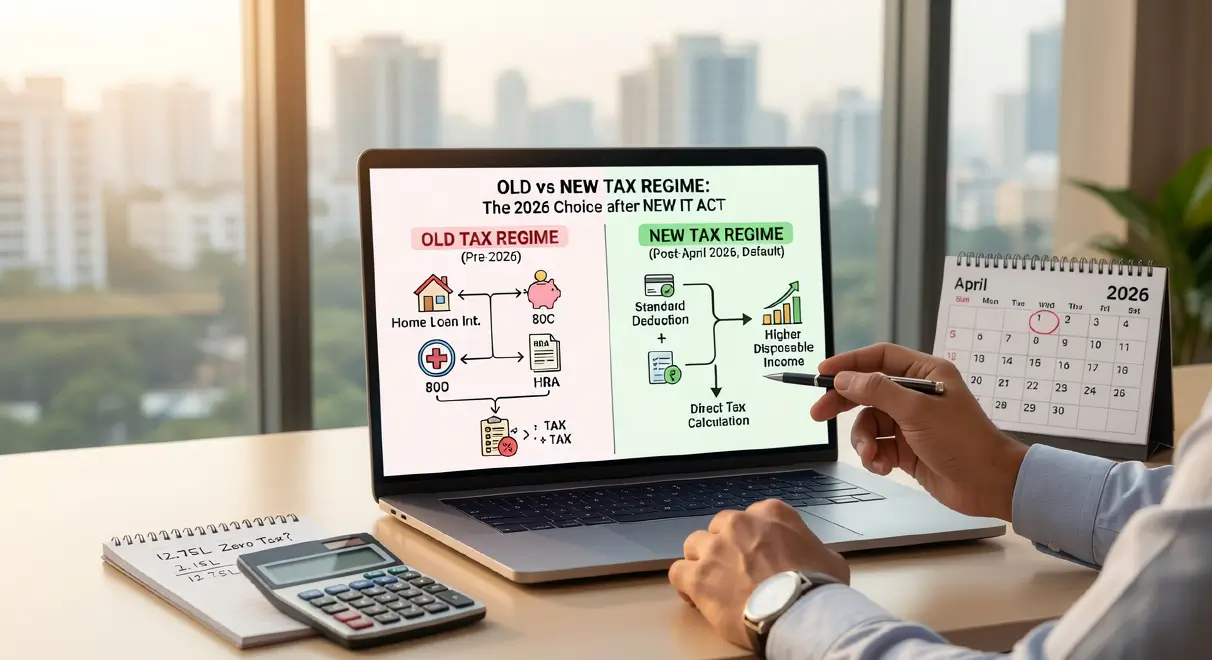
When the calendar turns to April many of us get a minor headache every year. It is not just about the weather; it is about choosing our tax regime for the year. But the decision for April 2026 feels even bigger. That is when the completely new Income Tax Act, which replaces the sixty-plus-year-old law, will fully affect our payslips. I’m hearing a lot of confusion at office pantries and family dinners about how this new law impacts the choice between the old tax regime and the new tax regime. Everyone wants to know the simple math: where do I pay less tax?
The core challenge remains the same. The old regime is like a demanding fitness coach; it forces you to save money in specific places like LIC, ELSS Mutual Funds, or PPF to get tax deductions. The new regime, which is now the default option and heavily promoted under the new Act, is simpler. It doesn’t care where you invest, but offers much lower tax rates and significantly higher tax rebates. The gap is widening with the 2026 changes. The government really wants us to shift to the new, streamlined way. Let’s figure out if it is time to make that shift for good.
Table of Contents
Logic Behind the Two Tax Regime Choices
We need to understand why these two tax regimes even coexist. The old regime was designed when India didn’t have a strong digital footprint. Encouraging long-term savings through tax exemptions was a public policy goal. However, it became too complex with over a hundred different exemptions available. The new regime aims to reduce paperwork and litigation. It focuses on higher disposable income. The thinking is that you are smart enough to invest your own money without being forced by a tax deadline.
When the new IT Act lands, the old tax regime’s complexity gets even more scrutinized. Some niche deductions that few people used might be merged or scrapped to make accounting cleaner. On the other hand, the new tax regime is designed to be the “fast track.” The logic is that you should spend ten minutes filing your taxes, not ten hours. This simplified approach is the real goal of the new tax era starting in April 2026.
Major shifts under the new IT Act impacting 2026
The most striking change coming with the new law is the complete overhaul of the “rebate” system. You might recall that right now you pay zero tax if your taxable income is up to 7 lakh under the default regime. Under the 2026 rules that rebate is likely to be tweaked to cover an effective income of nearly 12.75 lakh after standard deduction for salaried individuals. This is the biggest selling point for the new regime. It targets a huge section of the middle class who might pay absolutely zero tax.
The old tax regime on the other hand remains largely stagnant in its core 80C limit of 1.5 lakh. That limit was set in 2014 and has not been revised since. Inflation has made that 1.5 lakh worth much less. By 2026 sticking to the old tax regime means you are making forced investments that may not even match inflation just to get a small tax break. While HRA and Home Loan interest deductions are still massive reasons to stick to the old way the appeal of lower tax slabs is getting stronger every year.
Old vs New Tax Regime after New Act (April 2026)
| Parameter | Old Tax Regime | New Tax Regime (Default) |
| Tax Slabs | Higher rates (5%, 20%, 30%) but fewer slabs | Much lower, progressive rates and more slabs |
| 80C Deductions | Available (up to 1.5 Lakh) | Not Available |
| HRA Exemption | Available | Not Available |
| Home Loan Interest | Available (up to 2 Lakh for self-occupied) | Not Available |
| Standard Deduction | 75,000 (Expected same as new) | 75,000 (Already active) |
| Zero Tax Limit | Lower effective limit (~5 Lakh taxable) | Very high effective limit (~12.75 Lakh) |
| Complexity | High (Requires managing proofs and investments) | Very Low (No proofs required, simple calculation) |
The “breakeven” points: The real-world numbers
Let’s talk about the actual math. The “breakeven point” is the specific amount of deductions you need to claim to make the old regime better than the new one. This point changes based on your income. The battle is between 80C, 80D (health insurance), and HRA or Home Loan interest for most salaried professionals.
- For Income up to 12.75 Lakh: For a salaried employee with standard deduction the new regime will likely result in zero tax from April 2026. Unless you have massive home loan interest exceeding 2-3 lakh the new regime is almost a guarantee for maximum savings. The sheer effort of managing 1.5 lakh in 80C investments isn’t worth it if you pay zero tax either way.
- For Income from 15 Lakh to 20 Lakh: This is the tricky range. To make the old regime better you usually need deductions exceeding 3.75 lakh to 4 lakh. This means you must have full 1.5 lakh 80C and a very healthy HRA claim or a massive home loan interest deduction (up to 2 lakh).
- For Income above 25 Lakh: Here the gap widens again. The highest tax slab of 30% in the old regime kicks in much earlier (above 10 lakh in old law structure). In the new regime you pay 30% only above 24 lakh. Even with full deductions the difference in tax rates often makes the new regime much better for high-income earners.
The effective limit of 12.75 lakh for zero tax in the new regime means that if your salary falls under this amount, you have very little reason to choose the old regime. Why block 1.5 lakh in PPF or ELSS if you can have that money in your hand and still pay zero tax? For people earning between 15-20 lakh the decision is the hardest. You need a mix of deductions like 80C, 80D, and either a significant HRA or Home Loan interest to beat the lower tax rates of the new system. Once you cross the 25 lakh mark the lower 30% threshold of the new regime usually wins. This helps high-earners save money without managing dozens of documents.
Practical tips to choose wisely
Your choice in April 2026 shouldn’t be a guess. It should be a calculation based on your life choices. Are you a minimalist who wants a higher in-hand salary? Choose the new regime. Are you disciplined saver who uses tax breaks to build your retirement fund? The old regime might still be for you.
Start by checking your current non-taxable allowances like HRA and LTA. Calculate your actual spending on 80C investments like children’s school fees, LIC, and ELSS. Add your 80D health insurance and any NPS contributions under 80CCD(1B). If this total number is far below the “breakeven point” for your income level then the new regime is a clear winner. Don’t let your HR pick the default for you. Run a simple tax calculator online with your expected income and deductions for the 2026-27 year. The few minutes you spend doing this can save you thousands of rupees.
Smart Financial Moves You Can Make Today
You don’t need to wait until April 2026 to start planning. If you are currently locked into investments purely for tax savings you should re-evaluate them. For example if you were buying ELSS every year perhaps it is time to shift that money into a direct mutual fund where you are not restricted by tax laws. If you have a home loan your interest will naturally decrease every year. Plan for the time when that deduction becomes too small to matter.
Talk to your HR about your salary structure. Are they maximizing allowances that are tax-exempt in the new regime? The new IT Act might simplify the overall structure so ensure your payslip is optimized for the future. The worst position to be in is realizing in July when you file your returns that you selected the wrong regime. Be proactive and calculate your projected liability for April 2026 by taking realistic numbers of your income and your forced deductions.
Conclusion
The old tax regime vs new tax regime debate will continue in 2026 but the battlefield has shifted. The new IT Act is a clear message that simplicity is the future. With an expected zero tax limit covering an effective income of 12.75 lakh the new tax regime is becoming impossible to ignore for most salaried Indians. While the old regime still holds massive value for those with large home loans or significant HRA it is slowly becoming a niche option. Choosing a tax regime is no longer about blindly chasing 80C. It is about cash flow, ease of filing, and long-term financial freedom. Spend some time understanding your own financial profile because the new tax era starting in 2026 demands that we become smarter with our choices. Don’t be afraid to leave the old forced savings behind if the new, simpler path puts more money in your pocket today.
Read More: India’s Tax Year System: Everything You Need to Know in 2026