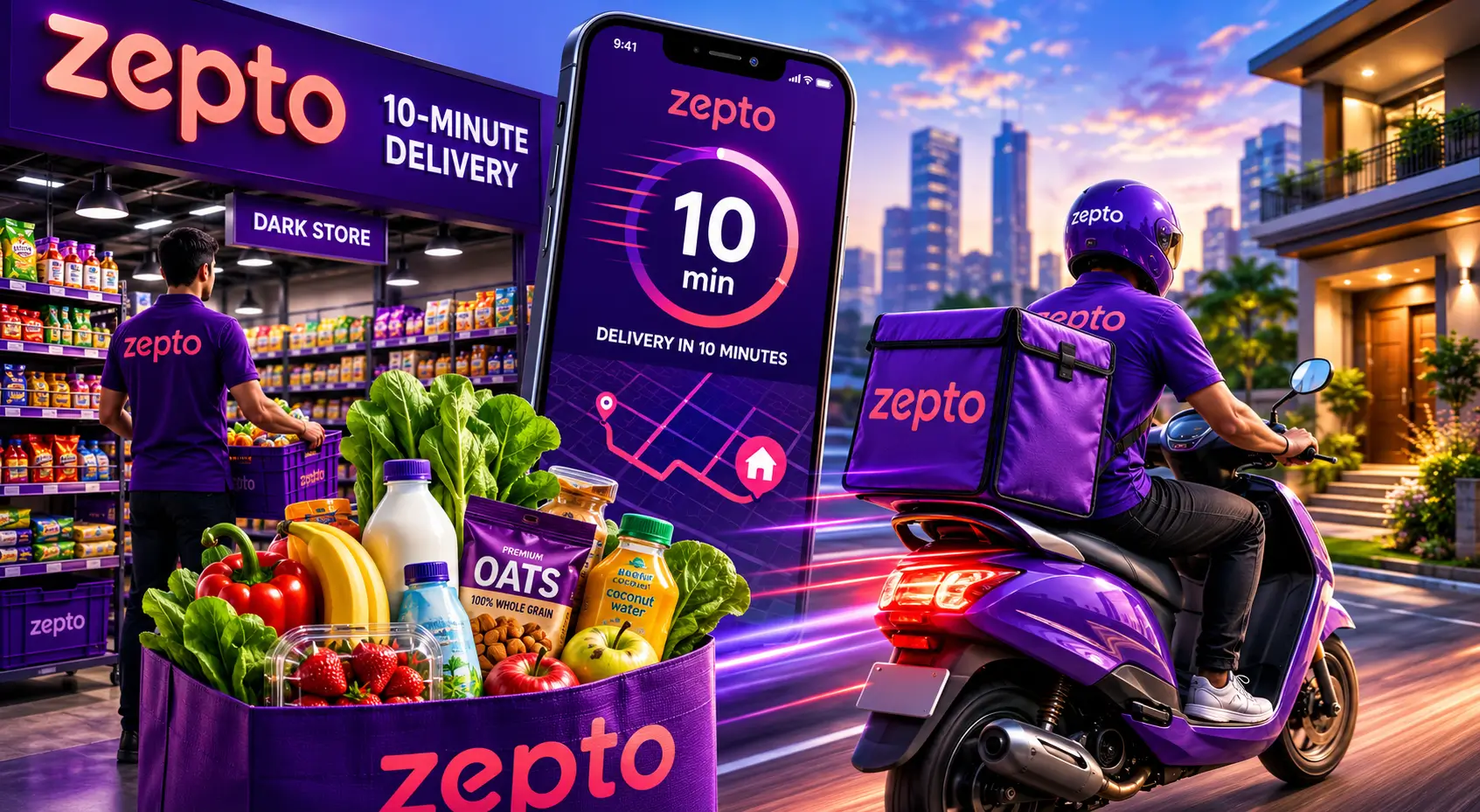
You can now get milk, bread, vegetables, or snacks delivered to your door in less than 10 minutes. A few years ago, this seemed impossible. Today, it is real thanks to a service called Zepto. Since starting in 2021, it has changed how people in India buy groceries by delivering items almost instantly instead of making customers wait for hours or days.
But the real question is:
How does Zepto manage to deliver so fast while building a multi-billion-dollar company?
This article will cover everything you need to know about:
- How it works
- How do they make money
- Their business model and costs
- Why do they use “dark stores”
- What makes them better than others
- The challenges they face
- Plans for the future
Table of Contents
What is Zepto?
Zepto is an Indian quick-commerce platform that delivers groceries, fruits, vegetables, personal care products, electronics, and daily essentials within minutes.
The company was founded by Aadit Palicha and Kaivalya Vohra.
Unlike traditional eCommerce platforms that operate from large warehouses, Zepto uses a network of strategically located micro-warehouses known as dark stores.
The Core Idea Behind Zepto
Zepto follows an Inventory-Led Quick Commerce Model.
This means:
- Zepto owns inventory.
- Products are stored in dark stores.
- Orders are processed from the nearest dark store.
- Delivery partners complete the last-mile delivery.
Because products are already stored close to customers, delivery times are dramatically reduced.
This model gives Zepto:
- Better inventory control
- Faster deliveries
- Higher customer satisfaction
- Better margins compared to marketplace models
How Zepto Works Step-by-Step
Step 1: Customer Places an Order
Customers browse products through the Zepto app and place an order.
Step 2: The store gets your request
The app automatically sends your order to the store closest to your house.
Step 3: Order Picking
Store workers quickly grab your items off the shelves and pack them up.
Step 4: Delivery Partner Assignment
A delivery partner is chosen instantly to pick up your order.
Step 5: Delivery Completion
The order reaches the customer within minutes.
The entire process is optimised through AI-driven inventory management and route optimisation.
What Are Dark Stores?
Dark stores are mini warehouses that look like supermarkets from the inside but are not open to customers. They exist solely to fulfil online orders.
Benefits of Dark Stores
Zepto’s secret to success is its network of “dark stores,” small, local warehouses that are closed to the public and used only for fast deliveries. Here is how this gives them an edge:
- Faster and closer: Because these small stores are spread out across neighborhoods, your order travels a very short distance to reach you.
- Smarter stock: They use smart systems to make sure the products you want are always on the shelves, preventing delays.
- Lower costs: Since these stores are simple and not designed for walk-in shoppers, it saves money on rent and operations.
- Higher efficiency: Everything is set up for speed. From the moment you click “order,” the layout of the store helps staff pack your bag in seconds, and riders are ready to go immediately.
Zepto Business Model Canvas
To make a 10-minute delivery possible, Zepto relies on a well-organized system. Here is a simple breakdown of how they operate:
1. Who Helps Zepto (Key Partners)
It work with a team of partners to keep things running:
- Suppliers & Brands: They get products directly from popular consumer brands and wholesale suppliers.
- Tech & Logistics: Companies that provide the software, servers, and delivery equipment.
- Investors: People who provide the money needed to expand and grow.
2. What Zepto Does Every Day (Key Activities)
To keep deliveries fast, they focus on these tasks:
- Managing Stock: Tracking items so they never run out of what you need.
- Predicting Demand: Using data to guess what people will buy so it is already in stock.
- Speeding Up Delivery: Constantly improving routes for riders.
- Running Stores: Operating their “dark stores” (small warehouses) efficiently.
- Finding Customers: Advertising the service to get new users on the app.
3. What Zepto Uses (Key Resources)
These are the core tools they need to function:
- The App: The primary way customers place orders.
- The Network: Their collection of local “dark stores.”
- The Fleet: The group of delivery riders and their vehicles.
- Tech & Data: Computers and information about what customers buy to stay organized.
4. Why People Choose Zepto (Value Proposition)
It focus on making life easier for you:
- Extreme Speed: Getting groceries in minutes.
- Good Prices: Staying competitive with local markets.
- Easy to Use: Shopping from home with just a few taps.
- Variety: Offering a wide range of everyday products.
5. Who Uses Zepto (Customer Segments)
Their services are designed for people with busy lives:
- Working Professionals & Families: People who are tired and need groceries fast.
- Students: Young people living away from home who need essentials fast.
- Urban Residents: People living in cities who value convenience and time-saving.
How Zepto Makes Money?
Many people assume Zepto only earns from grocery sales. In reality, it has multiple revenue streams.
1. Product Margins
This is Zepto’s largest revenue source. The company buys products from suppliers and sells them at retail prices. The difference becomes gross margin.
Examples:
- Grocery products
- Snacks
- Beverages
- Household items
2. Delivery Fees
When you place a small order. You have to pay a delivery fee. This charge helps the company cover the costs of picking, packing, and shipping your items.
3. Zepto Pass Subscription
Zepto offers membership plans that give you benefits like free delivery, special discounts, and extra offers. By joining, you get to save money on your regular shopping. At the same time, these plans help the company keep customers coming back more often. It also provides the business with a steady monthly income, which helps them continue providing great service.
4. Advertising Revenue
Companies like Zepto earn extra money by letting brands advertise on their app. Brands pay to have their products show up at the top of search results, appear on main banners, or get special promotions.
Think of it like paying for a better spot on a supermarket shelf. Because so many people use these apps to shop, brands are eager to pay for this prime digital space to get noticed. This has become a very popular and fast-growing way for quick delivery companies to make money. Zepto is selling more of its own branded products.
There are several reasons why they do this:
- Higher Profits: Because it is cutting out the middleman, they make more money on every item sold compared to selling another company’s brand.
- Customer Loyalty: Since these products are only available on Zepto, customers have to come back to the app if they want to buy them again.
- More Control: It makes the company less dependent on other brands. They don’t have to worry as much about other companies changing prices or running out of stock.
5. Private Label Products
It is increasingly selling products under its own brand name. These are often called “private labels.” Even though these products are made by partner factories, they carry the Zepto brand, meaning you can only buy them on the Zepto app.
Here is why they do this:
- Higher Profits: When Zepto sells another company’s brand, they have to share the profit. By selling their own brand, they cut out the middleman and keep more of the money from every sale.
- Customer Loyalty: Since these specific items are exclusive to Zepto, customers who grow to like them have to keep coming back to the Zepto app to buy them again.
- More Control: It makes the business less dependent on outside suppliers. They don’t have to worry as much about other companies changing prices, running out of stock, or leaving the platform.
6. Zepto Café
Zepto Café sells things like coffee, tea, sandwiches, and snacks. This is a smart way to make more money. You usually make a much bigger profit on a prepared meal than you do on basic groceries like milk or bread.
It can make more money on each sale, which helps the company become more profitable overall. Since these snacks and drinks are quick and convenient, they also encourage more people to use the app for their everyday needs.
Zepto Cost Structure
Running a business that delivers items in just 10 to 30 minutes is very expensive. Because they promise such fast delivery, companies like Zepto have to spend a lot of money to keep everything running smoothly.
Here are the main costs they have to cover:
- Rent for “Dark Stores”: These are small warehouses located in neighborhoods so items can be delivered quickly. Since these spaces are right in the middle of busy cities, the rent is very high.
- Employee Salaries: They need a large team to keep things moving. This includes the staff working inside the warehouses to pack your orders, the operations teams managing the logistics, and the support teams ready to help if you have a problem.
- Delivery Costs: Getting an order from the warehouse to your front door in minutes is the most expensive part. Paying the delivery riders for every trip adds up quickly.
- Technology: It takes powerful AI and computer systems to manage inventory, track thousands of orders, and make sure the app works perfectly 24/7.
- Marketing: To keep growing, the company constantly spends money on ads and promotions to attract new customers and keep existing ones shopping on the app.
Why Zepto Is Growing So Fast
- Convenience is King: People are increasingly choosing the comfort of home delivery over the effort of traveling to a store. Being able to get what you need in minutes is becoming a top priority for many shoppers.
- The Urban Lifestyle: Busy professionals living in cities often have very little time for chores. They rely on quick delivery to manage their daily needs without disrupting their tight schedules.
- Widespread Smartphone Use: Almost everyone now has a smartphone and feels comfortable using apps. This makes it incredibly easy for people to browse, pay, and order items with just a few taps.
- The Habit of Reordering: Since these apps sell things you need every day, like milk, snacks, and groceries. You end up using them again and again. This makes the service a regular part of your daily life.
By meeting these needs, quick commerce has moved from being a luxury to a reliable daily service for many urban households.
Zepto vs Blinkit vs Instamart
| Factor | Zepto | Blinkit | Instamart |
| Founded | 2021 | Earlier entrant | Part of Swiggy |
| Core Focus | Quick commerce | Quick commerce | Quick commerce |
| Delivery Speed | Minutes | Minutes | Minutes |
| Dark Store Network | Extensive | Extensive | Extensive |
| Revenue Streams | Multiple | Multiple | Multiple |
Competition among these platforms remains intense as companies invest heavily in dark-store expansion and customer acquisition.
Is Zepto Profitable?
Zepto is not yet profitable because it is spending heavily to grow quickly and reach more customers. While the company earns more money through sales every year, it also spends a lot on new warehouses, staff, and delivery costs. For now, it is choosing to focus on becoming a bigger part of your daily routine rather than focusing on short-term profits. Their goal is to get large enough that they can eventually cover their costs and become a sustainable, profitable business.
Major Challenges Facing Zepto
Despite its popularity, the quick-commerce business model is very difficult to make profitable. Because these companies promise to deliver items in just a few minutes, they face unique financial hurdles that typical online stores do not have to worry about.
Here are the main reasons why this business is so expensive to run:
- High Costs of Speed: To deliver in minutes, companies need many small warehouses (often called “dark stores”) spread throughout expensive city neighborhoods. Paying rent for these prime locations is a massive, constant expense.
- Thin Profit Margins: Groceries generally have low profit margins. This means that even when a customer buys something, the amount of profit the company makes on that item is very small, making it hard to cover the high costs of operations.
- Tough Competition: Because companies like Blinkit and Instamart are all fighting for the same customers, they often have to offer deep discounts or free delivery to stay competitive. This makes it even harder to earn a real profit.
- Unreliable Customer Loyalty: Many customers are “deal-seekers.” They often switch between different apps based on who is currently offering the best discount, which makes it expensive for companies to keep customers loyal.
- Constant Growth Expenses: Because the model relies on being close to the customer, expanding to new areas requires opening many new “dark stores.” This requires a lot of upfront money, which adds pressure to the company’s bank account.
In short, quick-commerce companies are in a race to find a balance where they can provide fast service without spending more on delivery and rent than they earn from their sales.
Future of Zepto
The future for Zepto looks very bright. Industry experts believe the quick-delivery market in India will grow significantly over the next few years. This growth is being pushed forward because more people are moving into cities, almost everyone now has a smartphone, and customers are getting used to the convenience of having items delivered in just minutes.
To keep growing, It is looking to expand into new areas beyond basic groceries, such as:
- More variety: Delivering electronics, fashion products, and ready-to-eat meals.
- New business models: Growing their own private brand labels and selling advertising space to other brands that want to be seen on the app.
- Broadening services: Offering other local services to become a “one-stop shop” for your daily needs.
To support this big vision, the company has successfully attracted a lot of investment. In fact, as of June 2026, Zepto is preparing for a major public stock market debut (IPO) to raise thousands of crores. They plan to use this money to open more neighborhood warehouses (dark stores), improve their technology, and reach even more customers across India.
Final Thoughts
Zepto became successful by promising to deliver your daily needs faster than anyone else. They use a smart business plan that includes running their own warehouses, using advanced technology to work quickly, and making money in several different ways, like selling memberships, showing ads for other brands, and selling their own store-brand products. All of these pieces work together to help them grow and change how people do their daily shopping.
Read More: 10 Top Pharma Companies in India: Who Leads the Industry?