
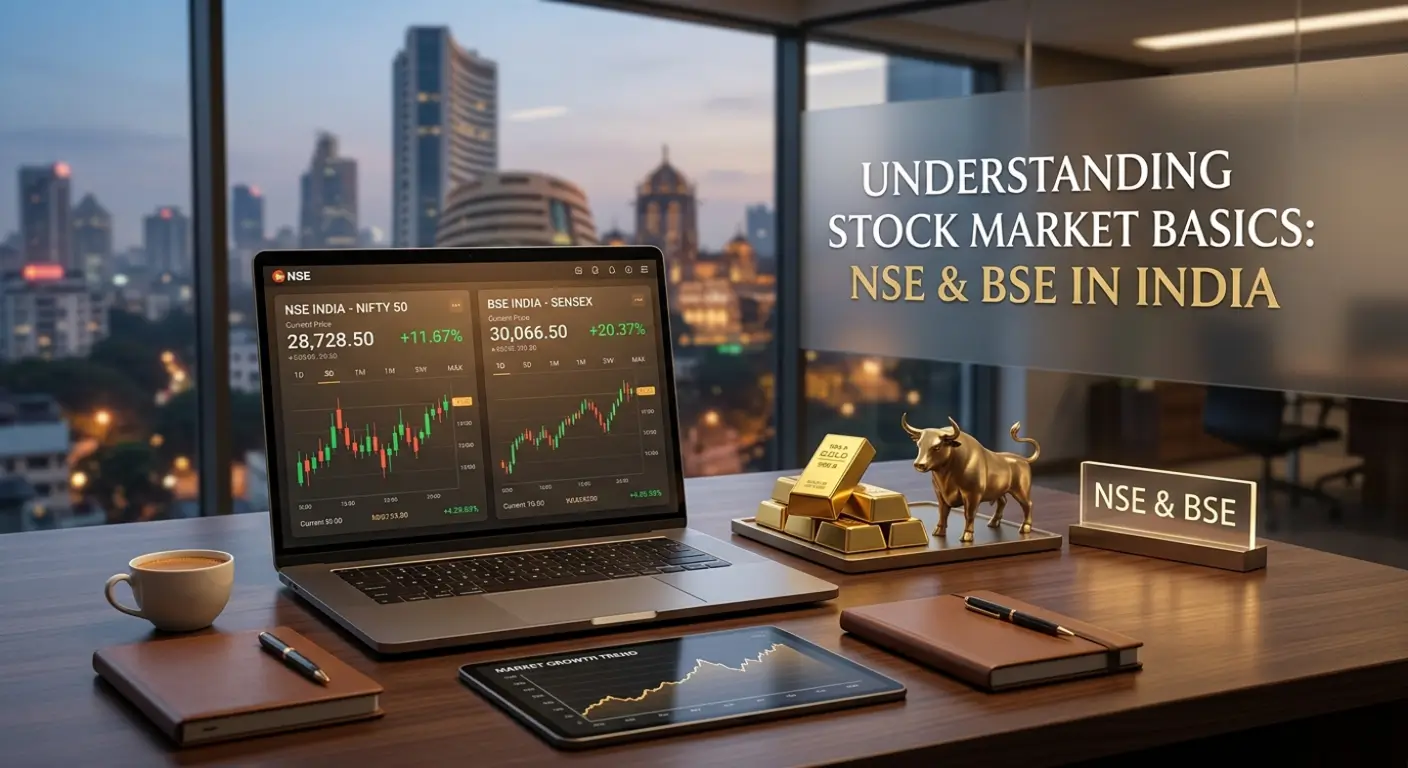
You must have seen two names appearing everywhere that you have ever opened a news channel or scrolled through a finance app. These are the National Stock Exchange (NSE) and the Bombay Stock Exchange (BSE). These terms will seem like a maze to a novice in the Indian share market who is just beginning their trading journey. You may be asking yourself why we have two exchanges and whether it matters at all what exchange you buy your first stock.
The fact is that, to create wealth in India, one should first learn about Dalal Street. Most individuals get into the trading business without understanding the fundamentals, and they find themselves lost when they observe varying prices on the same stock.
Table of Contents
What Exactly is a Stock Exchange?
A stock exchange is a large and coordinated market of companies. The same way you visit a local mandi to purchase vegetables or a mall to purchase clothes, investors visit an exchange to purchase shares. This occurs in India on two major platforms, which are the NSE and BSE. Instead, they offer a secure and controlled platform upon which buyers and vendors can interact electronically.
It would be a nightmare to buy a share without these stock exchanges. You would have to get someone who holds the stock and would desire to sell it at the same time as you. This is done in milliseconds by the exchange. They also make sure that the stock being sold by the person is in the possession of that particular person, and the person buying has the cash to purchase it. In this system, the money that you worked hard for is kept safe.
The Grand Old Lady vs the Modern Giant
Bombay Stock Exchange is the oldest in Asia, and it has a very rich history. This began at a banyan tree in Mumbai way back in the 1800s. It is home to nearly all the listed companies in India since it is so old. You check the BSE in case you want to know how the oldest businesses in the country are performing.
The National Stock Exchange, conversely, is the younger and more tech-savvy brother. It was introduced in the 1990s to introduce transparency to the Indian market. It pioneered the fully automated screen-based trading in the country. The majority of the daily trading volume is currently done on the NSE due to its amazing speed and efficiency. Although BSE boasts of a higher number of listed companies, it is in NSE where the big money tends to flow due to its high liquidity.
Comparison Table: NSE vs BSE at a Glance
| Feature | Bombay Stock Exchange (BSE) | National Stock Exchange (NSE) |
| Established | 1875 (Oldest in Asia) | 1992 (Modern Leader) |
| Benchmark Index | SENSEX | NIFTY 50 |
| Listed Companies | Over 5,000 | Over 2,000 |
| Trading Volume | Lower compared to NSE | Much Higher (Most Active) |
| Tech Focus | Traditional but upgraded | Pioneer of electronic trading |
Understanding the Pulse: Nifty and Sensex
It is impossible to refer to Dalal Street without Nifty and Sensex. These are referred to as indices. Since it is impossible to track thousands of stocks every minute, the exchanges created these small groups of top-performing companies to represent the whole market.
When the Sensex is up, it indicates that the thirty leading companies in the BSE are performing well generally. When Nifty is down, it is indicative that the 50 leading companies on the NSE are being sold off. Being a beginner, you must follow these figures on a daily basis due to the fact that they will inform you of the overall mood of the Indian economy.
How to Buy Your First Share?
Suppose that you wish to purchase 10 shares of Reliance Industries. When you open your broking application, such as Zerodha or Groww, you will find two options. One price will be that of NSE, and a slightly different price of BSE.
- NSE Price: ₹2,500.50
- BSE Price: ₹2,500.10
You may be inclined to take the cheaper one at all times. Nevertheless, you need to consider the volume or the number of people trading that stock. In most cases, it is just a few paise difference. This minor gap is not of much concern to a long-term investor. However, a 10-paise difference can make or break a profit or loss when trading thousands of shares in the case of a daily trader.
Important Basics Every Beginner Should Know
Before you invest in the market, you should know how the internal gears of Dalal Street work. The pillars of the Indian market are as follows, explained in a simple manner:
1. Liquidity in the Market and Its Importance
Liquidity is the ability to purchase or sell a share with ease and without significantly affecting the stock’s price. NSE boasts of extremely high liquidity due to the millions of individuals who trade within the exchange per second. When you purchase a stock in a low-liquidity exchange, you may not be able to sell your stock when you are in a rush to retrieve your money. Liquidity is high, which means that there is always somebody willing to assume the other end of your trade.
2. Demat and Trading Accounts
Stocks are not sold over the counter at the NSE or BSE. You require an intermediary known as a DP (Depository Participant), your broker. The buy or sell orders are placed using your Trading Account, and your shares are stored in a digital locker using your Demat Account. Previously, individuals received physical paper certificates, but nowadays it is all digital and is paid out within one or two days.
3. SEBI: The Investment Regulator
All exchanges report to the Securities and Exchange Board of India (SEBI), which is the boss. They are the ones who create the regulations that help to keep big business investors like us. They make sure that companies give fair financial reports and that brokers do not defraud their clients. The fact that SEBI is looking after Dalal Street makes the Indian investors confident to invest in the long run.
4. Listing and IPOs
A company issues its first IPO when it is seeking to get money from the public. After the process of IPO has been completed, the company is listed on the NSE or BSE. It is at this point that the company gets to be a public corporation, and anyone with a few thousand rupees can turn into a part-owner of that business.
Which is the best place to trade in NSE or BSE?
The NSE is more favored by most Indian professionals and expert traders due to speed and the increased number of buyers and sellers. Nonetheless, the BSE is ideal for locating small-cap firms that may not have been listed on the NSE yet.
When you are a novice and want to invest in blue-chip stocks such as TCS or HDFC Bank, it does not really matter what exchange you invest in. The important thing is the quality of the company, not the platform. Nevertheless, make sure that your broker is offering you a user-friendly interface to ensure you do not encounter a technical hitch during the trading hours.
Critical New Investor Tips
- Begin with the Index: Buy a Nifty 50 Index Fund as opposed to creating a portfolio of randomly selected stocks. This exposes you to the best 50 companies in India at a glance.
- Check the Volume: Before buying a stock, you should always check whether it trades well every day, since you will not be left holding shares that cannot be sold.
- Stay out of Penny Stocks: A lot of novices are enticed into buying stocks at 2 or 5 on the BSE. These are commonly pump-and-dump schemes. Stick to well-known names.
- Place Limit Orders: Place a Limit Order, which is an order to buy at the specific price that you are willing to pay, rather than buying at the market price.
- Remain informed but not freaked out: Keep up with the news to know why the Sensex is falling but do not, under any circumstances, start selling long-term holdings due to a one-day decline.
Conclusion
Dalal Street has ceased to be a reserved location of the elite in Mumbai. Every Indian is now empowered to increase his or her wealth with the emergence of digital applications and the strong systems of the NSE and BSE. The NSE is providing contemporary efficiency and liquidity, whereas the BSE is offering the largest number of listed companies and a reputation for trust.
The key to your financial freedom is to understand these exchanges. The red and green candles on the screen are not to be feared. Begin small, be able to be regular, and allow the Indian economy to do your work. It does not matter whether you invest in the Nifty or the Sensex; the idea is the same: to invest in the future of India and, at the same time, invest in your own future.
Read More: Stock Market Fall in April 2026: Opportunity or Red Flag for Investors?