
You have the thrill and nervousness that accompany investing your hard-earned money in the Indian stock market, mutual funds, or IPOs. But what happens when things go wrong? Or perhaps your broker is not sending your money, or a company is not sending you your dividends, or a mutual fund house is not paying your redemption.
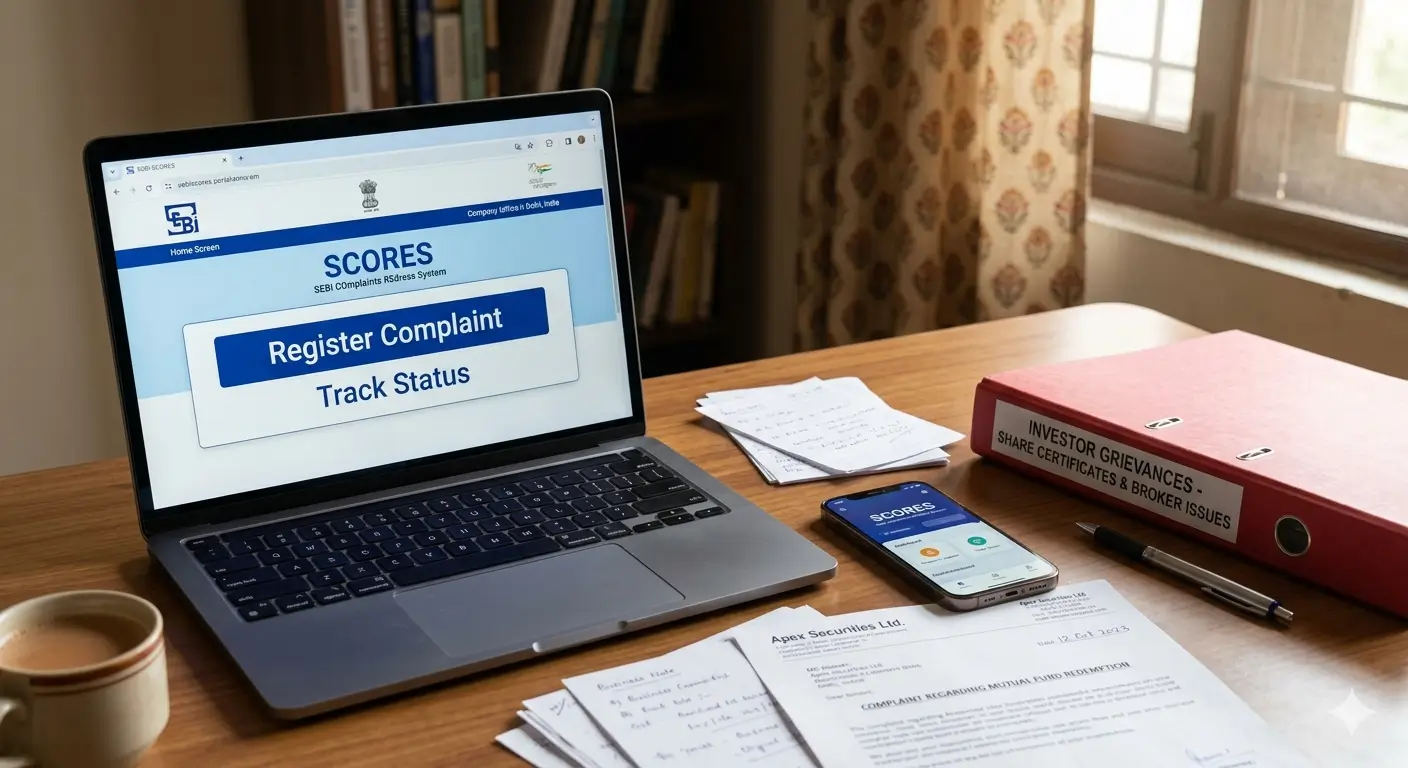
Previously, investors were used to feeling powerless as they always believed that they had to run all over the pillars to seek justice. But with the help of the SCORES (SEBI Complaints Redress System) portal by the Securities and Exchange Board of India, things have become much simpler. It is a web-based, centralized platform through which you can file a complaint and follow its progress from the comfort of your house.
In this article, we will understand exactly how to apply this system, what to expect, and some tips that work in practice to make sure that your grievance is actually resolved.
Table of Contents
What exactly are SEBI SCORES?
We should know what before we go leaping into the how-to. SCORES is basically an automated system that links you as an investor to the organization you have an issue with, with the SEBI overseeing it. Complaining here is not a chance mail. It is a formal ticket requiring the company or broker to respond within a given time.
Transparency is the beauty of this system. You can see every update, all responses of the company, and every comment of SEBI. It eliminates the sense of the black hole, whereby you report a complaint with no response.
Who can you complain to?
You can use SCORES for issues involving:
- Listed companies (regarding dividends, share transfers, etc.)
- Stock brokers and sub-brokers
- Mutual Funds
- Portfolio Managers
- Depository Participants (like NSDL or CDSL)
- Investment Advisers
The Pre-Requisite: Attempt Direct Resolution First
The biggest mistake that many Indian investors make is to rush to SEBI immediately when a minor problem arises. In fact, SEBI requires you to initially contact the concerned company or intermediary directly.
Consider it in the following way: in case your bank branch does something wrong, you first speak to the manager. When they do not listen to you or respond inadequately, then that is when you resort to the Banking Ombudsman. Likewise, you are to write an official email or letter to the compliance officer of the company or broker. Note down such communication. Unless they reply within 30 days or you are not satisfied with their reply, then that is your green signal to apply SCORES.
Step-by-Step Process to File a Complaint
Complaining is an online procedure. You don’t need to visit any office in Mumbai or Delhi. It works as follows:
1. Registration on the Portal
Go to the official SEBI SCORES website or download the SEBI SCORES mobile app. You will be required to create a new user. Having your PAN card, Aadhaar details, and your mobile number are handy. Your details will be verified through an OTP with the system. It is essential to give your proper email address since all further correspondence will occur there.
2. Filling the Complaint Form
Once you log in, click on “Complaint Registration.” You have to choose the type of entity (e.g., Mutual Fund, Listed Company). Then you have to give some basic information, such as the name of the company and the nature of the complaint. You should write only a specific problem. Rather than stating that they have stolen my money, state that the broker did not credit 50 shares of Reliance Industries to my demat account, although the payment was made fully on [Date].
3. Uploading Supporting Documents
This is a very crucial step where most of the invest fail. An accusation without evidence is merely a tale. You are to post PDFs of your contract notes, bank statements of the debit, or the emails you did not respond to previously to the company. Ensure that the files are clean and less than the file limit (which is normally 2MB per attachment).
4. Tracking and Action
Upon submission, you will be given a special Complaint Registration Number. Save this! You can do so to log in and check whether the company has replied or SEBI has requested additional information.
What Happens After You File?
Your complaint goes through a series of steps after it is in the system. It is not just sitting in a database, but is being monitored by SEBI officials.
| Stage | Action Taken |
| Submission | Your complaint is forwarded to the concerned entity (company/broker). |
| Response | The entity has to upload an Action Taken Report (ATR) explaining how they fixed it. |
| Review | SEBI reviews the ATR to see if the resolution is fair and as per regulations. |
| Closure | If satisfied, SEBI closes the complaint. If not, they may ask for further clarification. |
General Reasons for Complaints
Although there is risk in the stock market, the risk must be in the form of fluctuation of the prices and not the failure of operation. The following are the most popular areas of friction where SCORES can help you:
- Failure to receive Dividends: You had the shares on the record date, but the dividend has not been credited to your bank account even after weeks. When this happens, the company is usually guilty of having old bank records, and a SCORES complaint compels them to change and pay.
- Transfer of Shares: When you are attempting to convert physical shares to demat or transfer shares among accounts, and the company is procrastinating with it, SEBI can intervene in an attempt to expedite the process.
- Brokerage Problems: Brokers may sometimes make unauthorized trades (buy or sell without your consent) or deny you access to the balance in your trading account.
- Mutual Fund Redemption: When you are ordered to get out of the fund, and the money has not yet reached your account within the T+2 or T+3 days, and the AMC (Asset Management Company) is not providing a clear explanation, then SCORES is the best choice.
Expert Advice: How to make your complaint stronger
I am already aware of a number of cases that I have witnessed of people who have not been successful in this as an investor; the quality of your complaint is what makes the difference in the speed of resolution.
1. Be Brief and yet Full
Write not a 5-page essay. The timeline of events should be in bullet points. SEBI officers have thousands of cases; make them know yours in 30 seconds.
2. Talk of the “Loss” Specifically
In case they cost you a loss of money (e.g., you could not sell at a high price because the shares were not credited), indicate the amount you would have lost. Although SEBI does not necessarily provide compensation for notional loss, it further contributes to the severity of the negligence.
3. The “Follow-up” Rule
Monitor the status every 7 days. When you see that the company has posted an “Action Taken Report” which is not true or does not resolve your problem, you may reject the resolution and comment on it. A complaint is typically given 15 days to do so after it is marked resolved.
Limitations of SCORES
It is also significant to be aware of the limitations. SCORES is for regulatory and operational lapses. Not all the problems related to the markets can be solved by it.
- Market Losses: You can not complain when the stock price decreases, and you lose money. It is a market risk, not a complaint.
- Unlisted Companies: In case the company is not listed on the BSE or NSE and is a private company, then SEBI does not generally have any jurisdiction.
- Matters in Court: If you have already filed a case in a consumer court or a civil court over the same issue, SEBI will not normally interfere until the court decides on the matter.
- Commodities (Selectively): Although the majority of issues related to equity are addressed, there may be certain commodity issues that will be the province of other wings.
Basic Tips for Indian Investors
You should do the following in the next 24 hours in case you are experiencing a problem now:
- Check your records: Make sure you have the Client Master Report (CMR) with your broker and your most recent holding statement.
- Draft a “Final Warning” Email: Compose a final, clear email to the grievance cell of the company. Name it Final Notice before filing the SEBI SCORES complaint. Often, the mere mention of SCORES makes companies take you seriously.
- Organize your Proof: Take a screenshot of the error messages in your trading platform or the ignored position of your tickets.
Conclusion
Retail investors in India have found the financial environment a lot safer in the past ten years, and that is because of instruments such as SEBI SCORES. It gives everyone an equal playing field so that a small investor in a village will be heard the same as a large institutional player in Mumbai.
Keep in mind that the system is effective, and you need to take the initiative. Don’t allow a broker or a business to rest on your money. Take the first path, the Direct Resolution, but in case it fails, do not hesitate to use the SCORES portal. As an investor, it is your right to experience a fair and transparent experience in the markets.
Read More: SIP vs Stocks: Which is Better for Your Money in India?
The content on Probusinessline.com is for informational purposes only and does not constitute professional advice. Please verify information independently and consult a qualified professional before making any decisions. We are not responsible for any actions taken based on this information.