
Most of the Indian retail investors get into the stock market as per the tips provided to them on WhatsApp or news channels. They purchase a stock because somebody told them that it would increase by a month, and then they begin to see their price begin to decline. This is because they are flying in the air without a map. That map in the trading world is referred to as Technical Analysis.
Technical analysis is the art of understanding the past price movement so as to know the future price direction. It is premised on the fact that the market is a mirror of human psychology. Avarice and trepidation make a chart. These patterns allow you to quit gambling and begin trading rationally. In case you can read them. Its charts will always tell you a story, whether you are looking at the Nifty 50 or a small-cap stock at the BSE.
Table of Contents
Why Technical Analysis Works in 2026
The Indian market has evolved significantly over the last few years. The liquidity is higher than ever, with millions of new demat accounts opening. High liquidity means that technical patterns like “Head and Shoulders” or “Double Bottoms” work much better because thousands of people are seeing the same thing.
Unlike fundamental analysis, which requires you to read balance sheets for hours, technical analysis is visual. You don’t need a finance degree to see that a stock is struggling to cross a certain price point. You get a real-time view of what big institutional investors are doing by looking at the price and volume. Waiting for quarterly results is often too late in a fast-moving market. Technical Analysis gives you the entry and exit signals you need today.
The Foundation: Support and Resistance
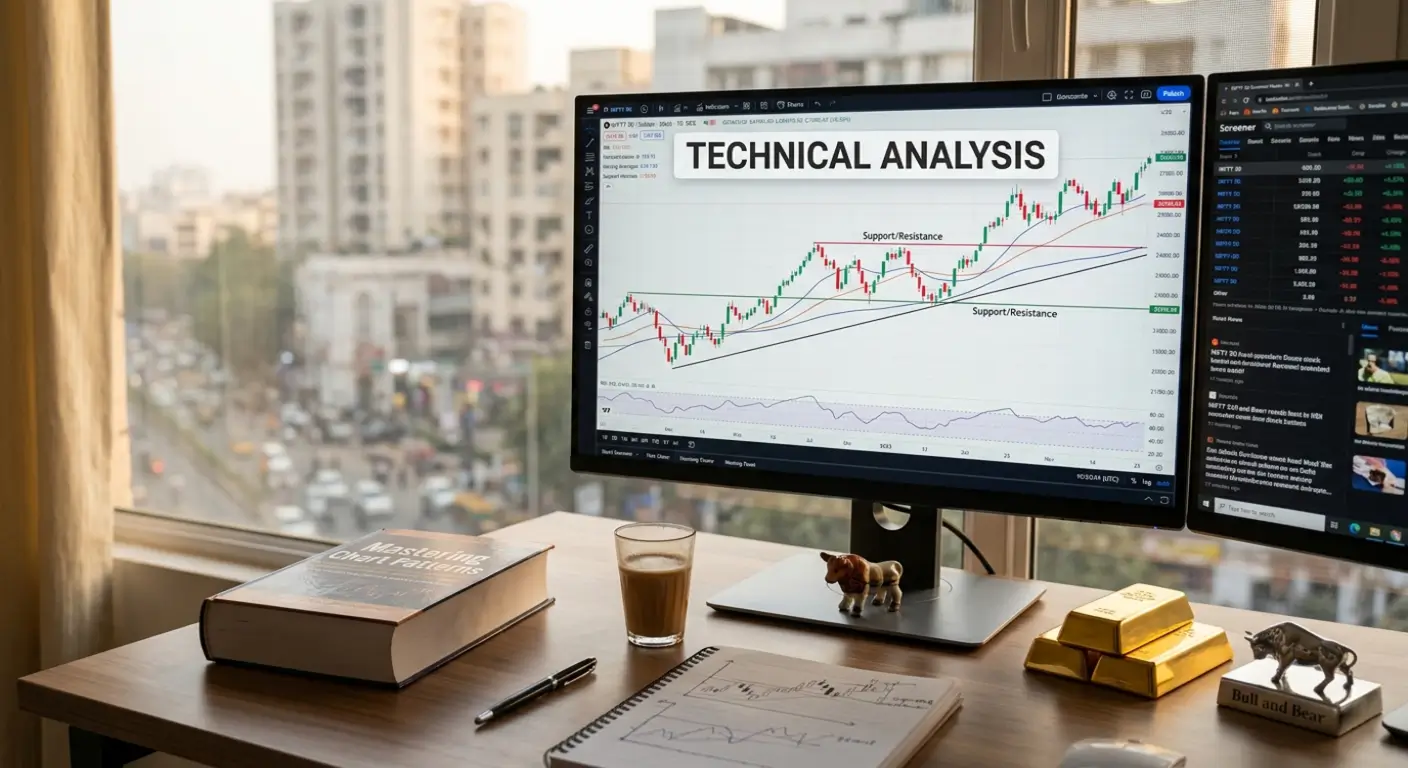
The most basic yet powerful concept in technical analysis is Support and Resistance. Think of Support as a floor that prevents the price from falling further. It is a zone where buyers feel the stock is “cheap” and start buying in bulk. Resistance is like a ceiling where sellers think the stock is “expensive” and start selling to book profits.
When a stock breaks above a strong resistance, it usually flies because the “ceiling” is gone. Conversely, if it breaks below support, it can crash quickly. Identifying these levels on a daily or weekly chart is the first thing an experienced trader does before putting even one rupee at risk.
Technical Analysis vs Fundamental Analysis
| Feature | Technical Analysis | Fundamental Analysis |
| Data Source | Price Charts and Volume | Financial Statements and Economy |
| Time Frame | Short to Medium Term (Days/Weeks) | Long Term (Years) |
| Goal | Find the right time to enter or exit | Find the “true value” of a company |
| Key Tools | Indicators and Patterns | PE Ratio and Debt-to-Equity |
| Main Focus | “When” to buy | “What” to buy |
Moving Averages: Riding the Trend
The trend is your friend in the Indian market. If the Nifty is in an uptrend, you should look for buying opportunities. One of the best ways to spot a trend is by using Moving Averages. A Moving Average smooths out the daily “noise” of price fluctuations to show you the overall direction.
Most Indian traders use the 50-day and 200-day Simple Moving Averages (SMA). If the price is above the 200-day SMA, it means the stock is in a long-term bull run. If a short-term average crosses above a long-term average, it is called a “Golden Cross.” This is often a signal that a massive rally is about to begin. Following these averages helps you avoid buying a stock that is in a “death spiral” or a long-term downtrend.
Understanding the Four Pillars of Technical Analysis
You must move beyond just looking at lines on a screen to be successful. Every trade you take should be backed by a solid framework of Technical Analysis. Here is a breakdown of how a professional trader plans their move:
1. Price Action and Candlestick Patterns
Candlesticks are the language of the market. Each candle tells you the opening price and closing price, plus the highs and lows. Patterns like the “Hammer” or “Shooting Star” show you exactly where the power shift is happening between buyers and sellers. A Hammer at the bottom of a downtrend suggests that buyers have taken control, and a reversal is likely. Understanding these shapes helps you feel the “pulse” of the market without needing complex math.
2. Volume as a Confirmation Tool
Price movement without volume is a trap. Suppose a stock price is going up, but very few people are trading it. This usually means the big players are not involved, and the move might fail. However, if the price breaks a resistance with huge volume, it means the “big boys” or Institutional Investors are buying. Always check the volume bars at the bottom of your chart. High volume confirms that the trend is real and has the strength to continue.
3. Risk-to-Reward Ratio
This is where most Indian beginners fail. They risk ₹10 to earn ₹2. A professional does the opposite. You should always aim for at least a 1:2 ratio. This means if you are willing to lose ₹1,000 if the trade goes wrong, you must aim to profit at least ₹2,000 if it goes right. Even if you are right only 50% of the time, this mathematical edge will keep you profitable in the long run.
4. Relative Strength Index (RSI)
The RSI is an indicator that tells you if a stock is “Overbought” or “Oversold.” It ranges from 0 to 100. Usually, if the RSI is above 70, the stock is getting too hot and might pull back. If it is below 30, it might be due for a bounce. Using RSI along with support and resistance levels gives you a high-probability setup. It prevents you from “chasing” a stock that has already run up too much.
Common Pitfalls to Avoid in the Trading Market
Analysis Paralysis occurs to many traders. They place 10 various indicators in their chart until they cannot even see the price anymore. Keep it simple. Price is king, indicators are mere helpers.
The other error is not taking into account the general market mood. When Nifty is plunging 2% per day, even the most promising technical arrangement in a single stock could not work. The most important thing to do is always to check the “Big picture” before zooming into a particular stock chart. Lastly, never trade without a Stop Loss. The market may be irrational even longer than you can stay afloat. A Stop Loss is your seatbelt in the unstable trading world.
Trading Journey Tips For Beginners
- Use Free Mapping Software: You don’t need to pay for expensive tools. Websites like TradingView or your broker’s own platform are more than enough for beginners.
- Paper Trade First: Practice your setups on a simulator for at least two weeks before using real money. See if your logic holds up.
- Stick to Liquid Stocks: Trade only in Nifty 100 or Nifty 200 stocks. These stocks follow technical analysis much better than illiquid penny stocks.
- Keep a Trading Journal: Write down why you took a trade and what the result was. This is the only way to learn from your mistakes.
- Avoid Overtrading: Taking 20 trades a day will only make your broker rich. Focus on 1 or 2 high-quality setups per week.
Conclusion
Technical analysis is not a crystal ball, but it is a potent lens to view the market. Once you master the level of support and the moving averages, and volume, you have an enormous advantage over the average investor who uses luck. It is a long time before you can learn to have an eye towards charts, but once you have this eye, you will see that the price movement tells you all you have to know.
Be disciplined with your risk and never give up, start small, and keep on learning. The Indian market in 2026 has unbelievable opportunities as long as one is ready to work. It is important to remember that eventually the news may be distorted and the opinions may be biased, but the charts will never lie.
Read More: Understanding Stock Exchange Basics: NSE & BSE in India
The content on Probusinessline.com is for informational purposes only and does not constitute professional advice. Please verify information independently and consult a qualified professional before making any decisions. We are not responsible for any actions taken based on this information.