
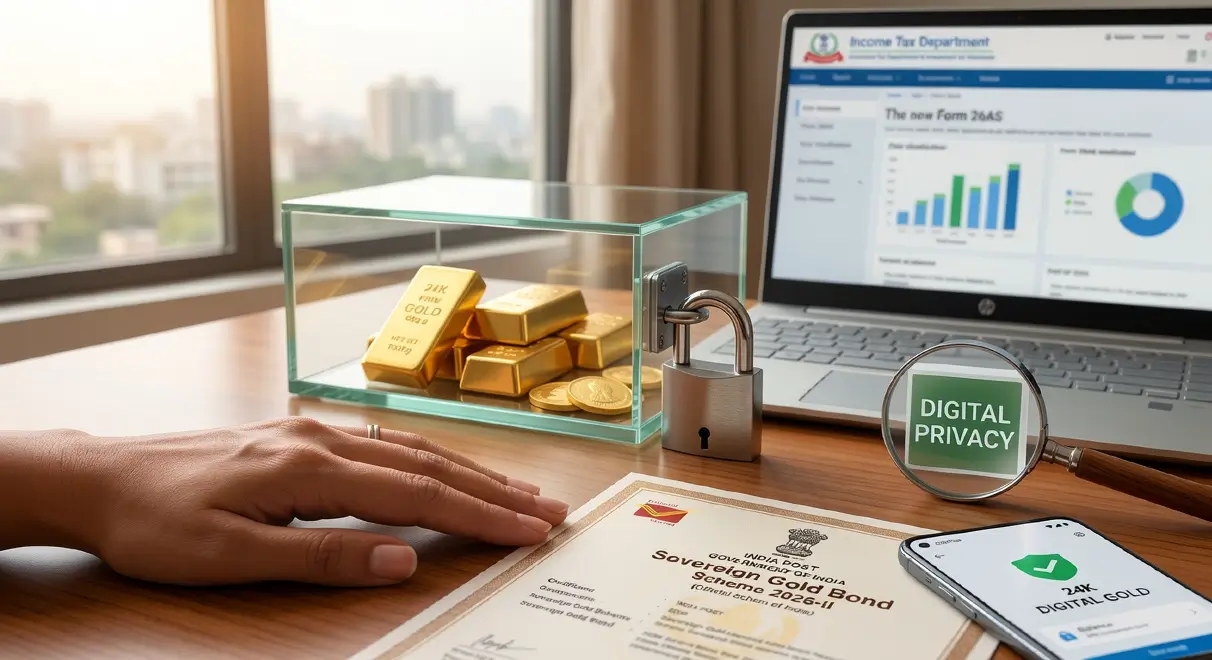
Gold is not just a metal for us in India. It is an emotion and a security blanket. Many of us grew up watching our parents visit the local jeweler every Dhanteras to buy a small coin or a chain. Carrying physical gold is risky, and storing it in bank lockers is getting expensive. This is why “Digital Gold” has become the talk of every household. You can buy it for as low as ₹10 using your UPI app while sitting on your sofa. It sounds perfect, but many people are now asking a very serious question. Is my digital gold actually safe?
The convenience of digital gold is its biggest selling point. You don’t have to worry about the purity or the safety of a locker. However, the digital world has its own set of rules and risks. Digital gold relies on a promise, and physical gold you can touch and feel. It is a promise that a company is holding real 24K gold in a secure vault on your behalf. Since the new IT Act and updated financial guidelines have come into play this year the safety landscape has changed. Let’s dive deep and see if this digital promise is worth your hard-earned money.
Table of Contents
How Digital Gold Actually Works in India
You are not actually buying from the app itself when you buy digital gold through apps like Google Pay, Paytm, or PhonePe. These apps are just “distributors.” The actual gold is managed with the help of three main companies in India. These are MMTC-PAMP, Augmont Gold, and SafeGold. When you swipe and pay these companies buy an equivalent amount of physical gold. They then store it in a highly secure vault which is usually insured.
This system is designed to give you “live” market prices. You can see your gold balance in grams in your app at any time. You can also sell it back to the company at the current market price and get money in your bank account instantly. If you accumulate enough grams you can even request physical delivery at your doorstep. It feels very smooth but you must remember that you are trusting a third-party entity with your wealth.
The Big Safety Question: Is it Regulated?
This is the part where you need to pay attention. The stock market is regulated by SEBI, and banks are regulated by RBI in India. But digital gold currently falls into a “grey area.” There is no single heavy-duty regulator specifically for the digital gold industry. SEBI has even restricted stockbrokers from selling digital gold because it is not considered a “security.” This doesn’t mean it is a scam, but it means you don’t have a dedicated government body to complain to if things go wrong.
The big three companies have appointed “Trustees” to solve this trust issue. A trustee is usually a reputable financial institution that monitors the gold vaults. They ensure that the amount of gold in the vault matches the amount of gold sold to customers. While this adds a layer of safety, it is still a “self-regulated” mechanism. In 2026, the government is still discussing stricter norms for this sector. Until then, your safety depends entirely on the reputation of the platform and the vault keeper you choose.
The Hidden Risks You Often Ignore
Safety is not just about someone stealing your gold. Safety is also about not losing money to hidden factors. The biggest risk in digital gold is the “Spread.” When you buy digital gold you pay the market price plus GST of 3%. But when you sell it back the company buys it at a lower price. This gap between the buying and selling price is called the spread. In India, this spread can be as high as 3% to 6%.
This means if you buy gold today and sell it tomorrow, you will immediately lose nearly 6% to 9% of your money. This makes digital gold a bad choice for short-term trading. Another risk is the “Storage Limit.” Most platforms allow you to store gold for free only for 5 years. After that, you either have to take delivery, sell it, or pay a small storage fee. If you forget about your account for ten years you might find your balance reduced by these charges.
Choosing the Right Platform in 2026
You must be very picky about where you buy, since regulation is light. Don’t just go for the app with the best cashback. Look at who the “Gold Provider” is. Most major apps use MMTC-PAMP because it is a joint venture between a Swiss firm and the Indian government. This gives a much higher sense of security compared to smaller private players.
You should also check the “Delivery” terms. Some platforms charge a very high making and delivery fee when you want to convert your digital grams into a physical coin. If the goal is to eventually have physical gold check these charges beforehand. In 2026 many banks have also started offering their own versions of digital gold which might feel more trustworthy for conservative Indian families.
- Check the Vault Provider: You should always see if the platform uses a reputed provider like MMTC-PAMP. This is a globally recognized name and follows the highest standards of gold purity and security.
- Understand the 3% GST: You must remember that every time you buy digital gold you are losing 3% to the government immediately. This is not a fee by the app but a mandatory tax that you cannot get back.
- Monitor the Spread: You should compare the buy and sell prices on the app before clicking. A spread higher than 4% is usually a sign that the platform is charging you too much for the convenience.
- Verify the Trustee: You must look for the name of the independent trustee appointed by the platform. Reputable names like IDBI Trustee or Vistra give you an extra layer of legal protection.
- Avoid Long-term Inactivity: You should not treat digital gold as a “set and forget” investment for 20 years. Because of storage limits you must review your account every year to avoid unnecessary fees.
Checking the vault provider is essential because your gold is only as safe as the place it is kept. MMTC-PAMP uses world-class security which reduces the risk of physical theft. Understanding the GST is vital because it affects your profit calculations. If gold prices go up by 5% you might still be in a loss because of the 3% GST you paid. Monitoring the spread helps you find the cheapest way to buy. Some apps have a 2% spread while others have 5%. Over a large amount this makes a huge difference. Verifying the trustee ensures there is a “watchman” looking at the gold for you. Finally avoiding inactivity is a practical tip to save on storage costs that start after a few years.
The cost Breakdown: Is it worth it?
Let’s look at a real-world example. Suppose you have ₹10,000 to invest. If you buy digital gold you pay ₹300 as GST right away. You get ₹9,700 worth of gold. If the spread is 3% your “Sell Value” at that very moment is only ₹9,400. You are already down by ₹600.
For the same ₹10,000 if you buy a Sovereign Gold Bond (SGB) you pay zero GST, and you even get 2.5% interest every year. However, SGBs have a lock-in period of 8 years. Digital gold is for someone who wants the flexibility to sell at midnight on a Sunday. It is a “convenience product” more than a “wealth-building product.” If you are saving for a wedding 10 years away digital gold might be too expensive due to the spreads and storage limits.
Smart Steps for Smarter Digital Gold Investing
1. Set a strict cap on your investment
You should not keep more than 5% of your total savings in digital gold. While it is perfect for small monthly savings, it is not the best place for large sums of money. For bigger amounts, you should consider Sovereign Gold Bonds (SGBs) or Gold ETFs, as they are much safer and more cost-effective in the long run.
2. Always download your gold invoices
You must make it a habit to download the official “Gold Invoice” immediately after every purchase. This document is your only legal proof of ownership. In case of any technical glitch on the app or a dispute with the platform, this invoice will be your primary evidence to claim your wealth.
3. Use automated “SIP” features for discipline
You should use the “Gold Locker” or SIP features available on most Indian apps to build a steady habit. Buying as little as ₹100 worth of gold every week automatically helps you save without feeling the financial pinch. It is a great way to average out the purchase price over time without checking the market daily.
4. Verify physical delivery to your pin code
You must check if the platform actually provides “Physical Delivery” to your specific location before you start investing. There is no point in accumulating grams of gold if the company cannot ship the physical coins or bars to your doorstep in a small town when you finally need them.
Conclusion
Digital gold in India is “safe” in the sense that your money is usually backed by real gold in a vault. But it is not “safe” from the risks of price spreads and the lack of a strong central regulator. It is a fantastic tool for the modern Indian who wants to start small and avoid the hassle of a physical jeweler. However, you must be more cautious with large investments. Treat digital gold as a stepping stone. Once you have saved enough, move that money into more regulated options like Gold ETFs. The digital age has made gold accessible to everyone from a college student to a rickshaw puller. Just make sure you read the fine print and choose a provider that has a rock-solid reputation. Your gold is your future security, so don’t let a “convenience” app be the reason you lose sleep.
Read More: Stock Market Fall in April 2026: Opportunity or Red Flag for Investors?
The content on Probusinessline.com is for informational purposes only and does not constitute professional advice. Please verify information independently and consult a qualified professional before making any decisions. We are not responsible for any actions taken based on this information.