
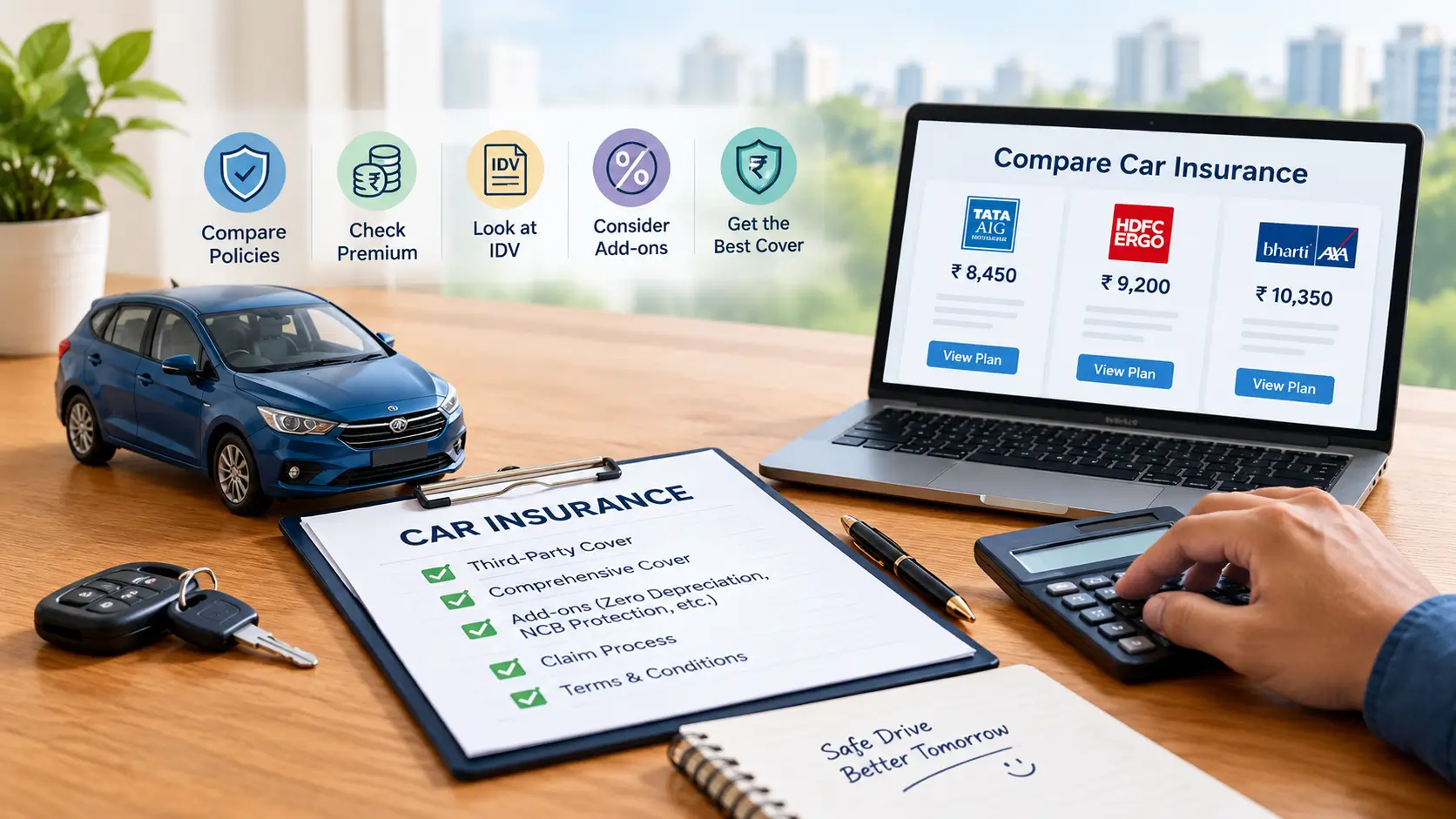
Buying car insurance in India can feel confusing. You see different insurance companies, different premiums, add-ons, discounts, and coverage options. One policy may cost Rs. 9,000 while another may cost Rs. 2,000. At first glance, the cheaper policy may look like the better deal.
But car insurance is not just about finding the lowest premium. A cheaper policy can have a lower IDV, higher deductible, or fewer useful covers. On the other hand, a slightly more expensive policy may offer coverage that better suits your car and driving needs. The good news is that you do not need to be an insurance expert to compare policies. You just need to understand a few important terms and compare similar coverage.
Is Car Insurance Mandatory in India?
By law, every car in India needs third-party insurance. It protects you by paying out if you accidentally hurt someone or damage their property. However, third-party insurance does not provide the same protection for damage to your own car.
If you want protection for your own vehicle, you can consider a comprehensive or package policy or a standalone own-damage policy along with the required liability cover. So before comparing prices, first decide what type of protection you actually need.
Types of Car Insurance You Can Consider
There are two broad types of car insurance coverage that most car owners should understand.
1. Third-Party Car Insurance
Third-party insurance covers your legal liability towards other people when your vehicle causes covered injury or property damage. It usually costs less than policies that also cover your own car because it does not provide the same own-damage protection. If your main goal is to meet the legal insurance requirement, third-party insurance is the basic cover you need.
2. Comprehensive Car Insurance
A comprehensive or package policy can cover third-party liability as well as damage to your own insured vehicle, subject to the policy terms and exclusions. Your own car can face risks such as accidents, theft, fire, and certain natural or other covered events. The exact protection depends on the policy you purchase. For many car owners, especially those with newer or higher-value cars, understanding the own-damage portion of the policy becomes important.
How to Compare Affordable Car Insurance in India
The best way to compare car insurance is to compare similar coverage from different insurers. IRDAI itself advises consumers to shop around and says getting three or more comparison quotes can be worthwhile. It also warns buyers not to compare premium alone because deductibles, coverage, and IDV can differ between policies.
Here is what you should check.
1. Compare the Same Type of Coverage
Do not compare a basic third-party policy with a comprehensive policy and call the cheaper one a better deal. First decide what type of cover you need. Then compare policies offering broadly similar protection. For example, if you want comprehensive insurance, compare comprehensive policies rather than comparing one comprehensive policy against a third-party-only plan.
2. Check the Premium
Premium is the amount you pay for the insurance policy. Of course, price matters when you are looking for affordable car insurance. But do not choose a policy simply because it has the lowest premium. Two insurers can charge different premiums for similar own-damage coverage. IRDAI says insurers consider several factors when calculating own-damage premiums, including vehicle age, IDV, previous claims, and applicable discounts or loadings. Think of premium as one part of the comparison rather than the entire comparison.
3. Check the IDV Carefully
IDV stands for Insured Declared Value. It represents the insured value of your car for own-damage coverage. IRDAI says the IDV should reflect the vehicle’s current market value. Suppose one insurer shows a lower premium because it offers a lower IDV. That policy may look cheaper on the comparison screen. But you should ask yourself whether the IDV makes sense for your car. Do not reduce the IDV only to save a little money on the premium without understanding how it may affect a claim.
4. Understand the Deductible
A deductible is the amount you agree to pay out of your own pocket when you make a claim. For example, if your repair costs Rs. 20,000 and your deductible is Rs. 2,000, you pay Rs. 2,000, and the insurance company pays the rest.
The exact calculation depends on the policy. When comparing car insurance, check the deductible along with the premium. IRDAI specifically advises consumers to compare deductibles, coverage, and IDV instead of looking only at the premium.
5. Look at the No Claim Bonus
The No Claim Bonus (NCB) rewards eligible policyholders for claim-free years. According to IRDAI, the NCB applies to the own-damage premium rather than the liability premium. Under the norms described by IRDAI, it can start at 20% and progressively reach up to 50% for successive claim-free years. This can reduce the amount you pay when you renew your policy.
NCB belongs to the insured person rather than the vehicle. IRDAI also states that the NCB can be carried when changing insurers at renewal if the required proof is provided. So if you have built up an NCB, make sure you do not accidentally lose the benefit while changing insurers.
6. Choose Add-Ons Carefully
Insurance companies offer different add-ons that can extend the coverage of a base policy for an additional premium.
Common examples include:
- Zero depreciation cover
- Return to invoice cover
- NCB protection
- Roadside assistance
IRDAI lists zero depreciation, return to invoice, and NCB protection among common motor insurance add-ons. You do not need every add-on. Think about your car’s age, usage, location, and your own needs before paying extra. Read the conditions of each add-on because coverage and exclusions can differ between insurers.
What Is Zero Depreciation Cover?
With standard motor insurance, depreciation can affect the amount payable for certain parts during a claim. A zero depreciation add-on can reduce the impact of depreciation on covered parts, subject to the policy terms, limits and exclusions. It usually costs extra, so check whether the additional premium makes sense for your vehicle.
7. Check the Claim Process
Insurance becomes most important when something goes wrong. Understand how you need to report a claim and what documents or steps the insurer requires before buying a policy. Also check the insurer’s network garage information if cashless repair service matters to you. Do not judge an insurer only by its advertisement. Read the policy wording and claim-related information carefully.
8. Check Exclusions
Every insurance policy has situations that it does not cover. These exclusions matter because they tell you when the insurer may not pay a claim. Read the policy document instead of assuming that comprehensive insurance covers every possible problem with your car. If you do not understand a particular exclusion, ask the insurer or intermediary before purchasing the policy.
9. Give Correct Vehicle Information
When buying or renewing car insurance, provide accurate information about your vehicle and previous insurance. IRDAI notes that insurers commonly use details such as vehicle registration information, engine and chassis details, vehicle class, seating capacity, driver information, and previous claim history when determining premiums. Do not enter incorrect information simply to get a lower premium. A small saving today may create problems later if the information you provided does not match the actual vehicle or policy records.
How to Get Affordable Car Insurance Without Cutting Important Cover
The goal should not be the cheapest car insurance. The goal should be suitable coverage at a reasonable price. Start by deciding whether you need only the mandatory third-party cover or whether you also want protection for your own car. Then compare at least three suitable quotes.
After that, compare the IDV, deductible, add-ons, and coverage. Check whether your NCB has been applied correctly and remove add-ons that do not make sense for your situation. This approach can help you control the premium without blindly reducing useful protection.
When Should You Renew Your Car Insurance?
IRDAI says a motor policy is generally valid for one year and should be renewed before the due date. It also states that there is no grace period for paying the premium after the policy expires and that a break in insurance can result in vehicle inspection requirements. Renewing on time also helps you manage your NCB properly. Keep your previous policy documents and renewal information handy when comparing a new policy.
Simple Car Insurance Comparison Checklist
Before you pay for a policy, check these points:
| What to check | Why it matters |
| Policy type | Tells you what kind of protection you are buying |
| Premium | Shows your total policy cost |
| IDV | Indicates the insured value of your car |
| Deductible | Shows the amount you may have to pay during a claim |
| NCB | Can reduce eligible own-damage premium |
| Add-ons | Can provide extra protection for additional cost |
| Exclusions | Shows situations the policy does not cover |
| Claim process | Helps you understand what happens after an accident |
| Network garages | Useful if you want cashless repair options |
Final Thoughts
Finding affordable car insurance in India does not mean choosing the lowest price you see online. A better approach is to compare policies based on coverage, IDV, deductible, NCB, add-ons, and exclusions, along with the premium. IRDAI specifically recommends comparing multiple quotes and looking beyond price when buying motor insurance.
Take a few minutes to read the policy details before making the payment. Make sure the vehicle information is correct and understand what the policy actually covers. The right car insurance policy should fit your car, driving needs, and budget without leaving you with coverage you do not understand.