
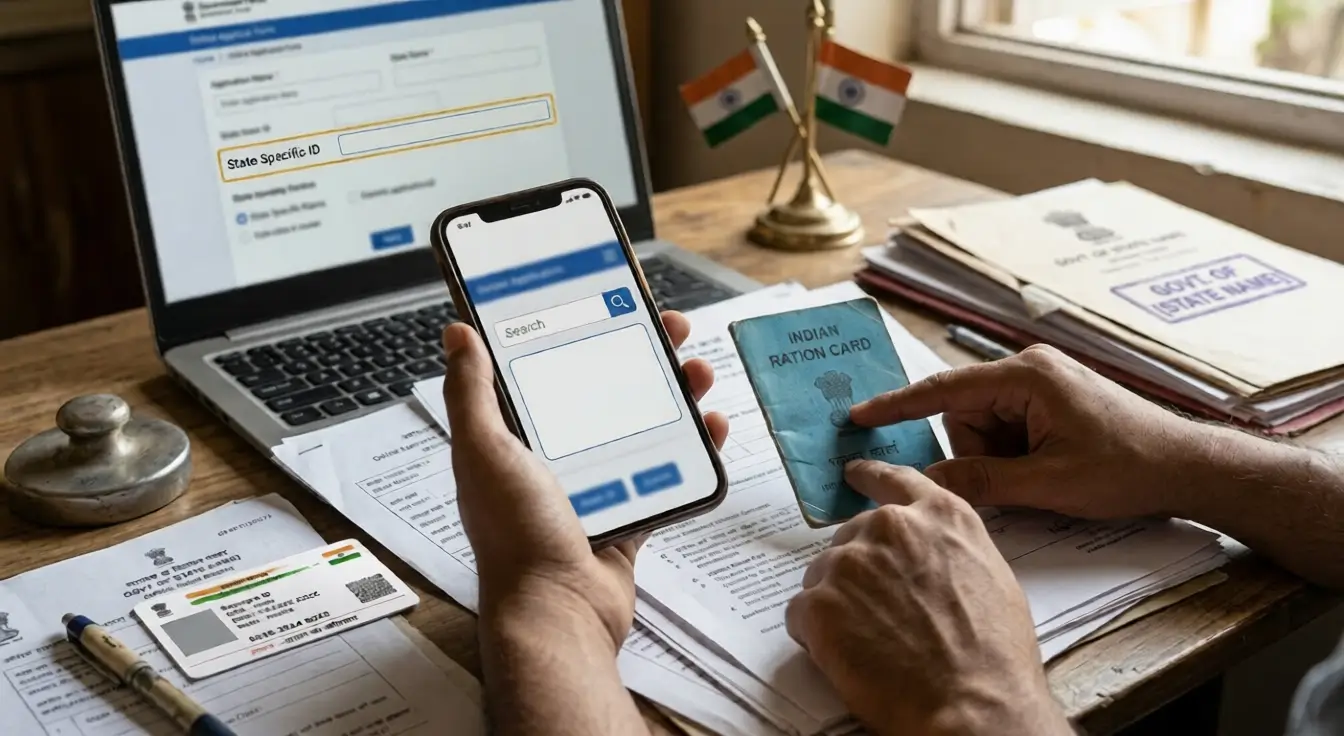
I am sure that you have been asked to fill in an online form in India in your entire life. If yes, you know how tiring it can be. You fill in your name and address. Even if you enter your Aadhaar card Number, all appears to be fine. You are then suddenly brought to a halt by a box. This box requires a state-specific ID.
You check your wallet. You can see your PAN card. You have your voter ID. None of them says ‘state-specific ID’, however. You begin to get perplexed. Do you have to visit a government office? Do you not know about some secret number?
Well, do not worry. You are not the only one who is confused. This is the very problem of thousands of students and job seekers on a daily basis. They become stagnant on websites such as the National Scholarship Portal (NSP). This is a guide that is going to assist you in solving this mystery. What this ID is, let us know. We shall also see how you can find yours at no cost to anyone. A lot of individuals stop at this point of application. They are afraid of doing something wrong. Today, that fear shall be cast aside.
Table of Contents
What is a State Specific ID?
A state specific ID is not a central card, such as Aadhaar. It is an individual identification number that is given by your respective state government. It is not issued by the central government.
So, why did states begin to issue these IDs? India is a huge country. Each state has its welfare schemes. State governments desired a means by which they could keep track of their own citizens. They desired to know who is benefiting and who is not. Aadhaar is wonderful for national identity. Nonetheless, states believed they had to have a more localized system. They were interested in knowing the needs of their people in particular.
Thus, various states developed their databases. The ID of somebody in Madhya Pradesh would not be the same as that of somebody in Rajasthan. Unless you are a resident of a state that has such an ID, this field is generally left blank. This is the reason why this field is optional in many forms. The fact that your state does not have one does not mean that you have to panic.
Why do states need a State Specific ID?
We will discuss and consider the actual cause of this system. Governments of states are spending crores of rupees on welfare schemes. They provide scholarships, subsidized food, and free medical care. Sometimes, fake beneficiaries take advantage of these schemes. This deprives the people of much-needed assistance.
At this point, the state specific ID comes into play. It is a kind of filter. It links your whole family together under one number. The government computer verifies this ID when you apply to a scheme. It can tell at a glance your family’s earnings and whether you are eligible or not. It prevents individuals from making spurious assertions.
This system prevents people from taking two benefits. It also simplifies the application process. You do not even need to send a stack of documents each time that you apply to a new scheme. Your data is already connected with this ID by the government. It facilitates the lives of both the government and honest citizens. It introduces much transparency to the entire system.
Aadhaar Card vs. State Specific ID
Consider how these two IDs differ from each other. People generally confuse them because they both look like identity numbers. This table will make things clear and simple.
| Feature | Aadhaar Card | State Specific ID |
| Issued By | Central Government (UIDAI) | Your State Government |
| Valid Location | All over India | Only in your specific state |
| Main Purpose | Individual identity proof | Managing state welfare schemes |
| Unit of Registration | Individual person | Mostly covers the entire family |
| Necessity | Required for almost everything | Required for specific state benefits |
As you may observe, the two are very different in their roles. One cannot take the place of the other. One determines your identity in India. The other establishes what benefits you can get in your home state.
Some Important State Specific IDs in India
This list will demonstrate what your state refers to as State Specific IDs. Keep in mind that not all states have been able to implement this system completely. The most famous ones are the following:
1. Samagra ID (Madhya Pradesh)
If you belong to Madhya Pradesh, you definitely know about this. The MP government uses the Samagra portal to track citizens. They give you a 9-digit unique ID for an individual. They also give an 8-digit ID for the whole family. You need this ID for getting rations, school admissions, and state scholarships.
2. Jan Aadhaar Card (Rajasthan)
Rajasthan uses this card. It replaced the older Bhamashah card a few years ago. It acts as a single identity for the whole family. The state uses it for direct benefit transfers. If you want to avail of the Chiranjeevi health insurance scheme, this ID is a must. A unique feature of this card is that it recognizes the woman of the family as the head.
3. Parivar Pehchan Patra (Haryana)
This belongs to the residents of Haryana. The government there has made it almost mandatory for all state services. It is an 8-digit unique ID. It helps the government track family data like income and age automatically. This stops fraud in old-age pensions and other schemes. Local committees verify the income data to keep it accurate.
4. Kutumba ID (Karnataka)
This is a digital initiative by the Karnataka government. They created a family database to identify eligible beneficiaries automatically. It helps students get scholarships without running to offices for income and caste certificates. The system pulls data directly from other government departments.
Cost Analysis: Getting Your State Specific ID
Many people think getting these IDs costs a lot of money. They go to local cyber cafes and pay heavy fees because they are scared of the online portal. Let us look at the actual cost breakdown. This will help you save your hard-earned money.
| Activity or Service | Doing It Yourself (Online) | At a Cyber Cafe or CSC |
| Registration Fee | ₹0 (Government keeps it free) | ₹0 |
| Form Filling Charges | ₹0 | ₹50 to ₹150 |
| Document Scanning | ₹0 (Use mobile phone) | ₹20 to ₹50 |
| Physical Printout | ₹0 (Keep it digital) | ₹10 to ₹20 |
| Total Cost | ₹0 | ₹80 to ₹220 |
As you can see, the government does not charge any money for these IDs. The process is completely free on official portals. If you know how to use a smartphone, you can do it yourself. You do not need to pay for a cyber cafe unless you are not comfortable with online forms. Many cyber cafes charge money just because people do not know the online process. You can save this money easily with a little effort.
What to do if your state doesn’t have State Specific ID
I have seen many students lose out on scholarship deadlines because of this one field. They panic and give up. Here is my expert advice to you: do not panic.
If you live in a state like Delhi, Maharashtra, or West Bengal, you might not have a dedicated family ID like Samagra or PPP. In that case, the portal will allow you to proceed without it. Just leave the box blank.
Critical Warning: Do not enter your 12-digit Aadhaar number in the State Specific ID box by mistake. The computer system might reject your application because the digit length won’t match.
Another important tip is to keep your data updated. People change their mobile numbers or addresses. If you do not update this in your state portal, you might face problems during verification. Spend ten minutes every year to check if your profile is correct. This small check saves you from running around offices later.
Conclusion
There is no need to make filling out government forms a nightmare. You have discovered just what a state-specific ID is. It is simply a state-level identity so that you can easily get welfare benefits. It introduces accountability to the system and assists the government in getting the right individuals.
Do not allow a little blank box to make you give up on your dream job or scholarship. Please use your ration card or the state portal to find your ID. Keep it in mind in the future. The next time you look at this box on a form, you will be much more confident.
Frequently Asked Questions
1. Is State Specific ID mandatory for all schemes?
It is not mandatory for all schemes. It is required for state-funded schemes or certain portals such as NSP. It is usually optional unless otherwise specified in the case of central schemes.
2. Can I use my Voter ID as a State-Specific ID?
Generally, no. Voter ID is an overall ID that is provided by the Election Commission. State-specific ID is a type of system, such as Samagra or Jan Aadhaar, that is state-welfare-specific.
3. My state doesn’t have an ID. What should I fill in the form?
If the field is marked with a red asterisk (*), look for a “Not Applicable” option. If it is not marked, simply leave it empty. The system will recognize your state selection and skip that requirement.
4. How long does it take to generate a new State ID?
After applying online, it takes 7-15 days on average to have the local authorities (such as the Tehsildar or Block office) validate your information. Your digital copy will be instantly downloaded after verification.
Read More: 100 Baisa in Indian Rupees: Latest Value & Easy Currency Conversion Guide