
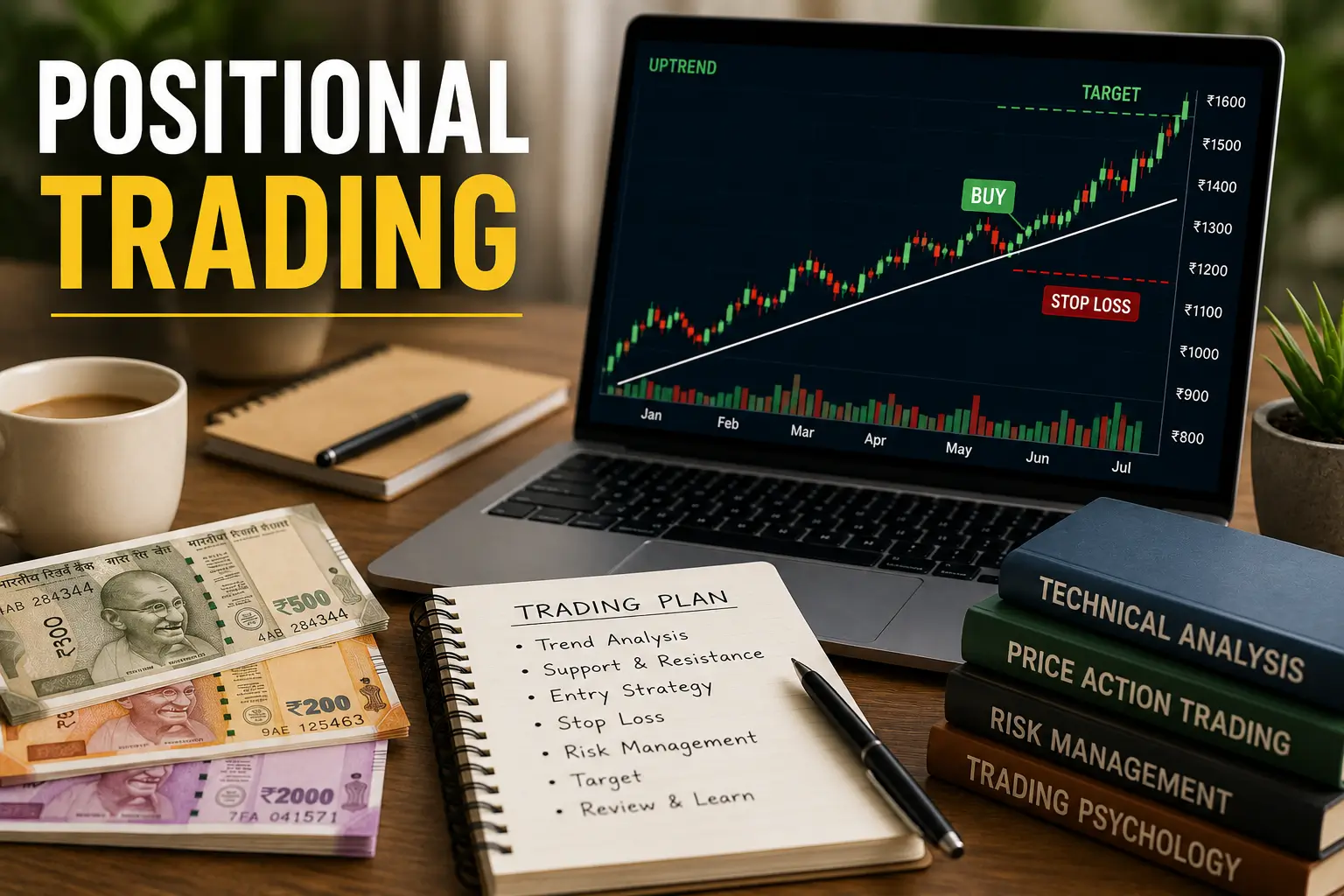
Many people join the stock market hoping to get rich quick. They buy a stock in the morning and hope to sell it for a profit by the end of the day. It means you have to watch the market constantly and make fast decisions. Not everyone has the time or temperament for that style of trading.
This is where positional trading can offer a different approach. A positional trader usually holds a stock or other eligible market position for several days, weeks, or sometimes longer, depending on the trading plan and market trend.
You do not need to sit in front of your screen throughout the trading day. Instead, you focus more on the broader price movement and try to benefit from a meaningful trend.
However, positional trading does not mean easy money. Markets can move against you, and every trade carries risk. A sensible strategy, proper research, and disciplined risk management matter much more than simply finding a stock that looks attractive.
What Is Positional Trading?
Positional trading involves holding a market position beyond a single trading session with the aim of benefiting from a larger price movement.
For example, suppose a trader studies a stock and believes that it has entered a strong upward trend. Instead of buying and selling the same day, the trader may hold the position for several days or weeks while the trend continues.
The trader usually has a planned entry price, a level that signals when the trade has gone wrong, and a profit objective or exit plan. The exact holding period can vary. Positional trading does not have one fixed number of days.
Positional Trading vs Day Trading
The biggest difference comes from the holding period and the way traders manage their positions.
| Feature | Positional Trading | Day Trading |
| Holding period | Days to weeks or longer | Usually within one trading day |
| Screen time | Generally lower | Usually higher |
| Main focus | Larger price trends | Short-term price movements |
| Decision speed | Relatively slower | Often very quick |
| Risk | Still significant | Still significant |
| Suitable approach | Patience and planning | Quick execution and discipline |
Neither approach automatically guarantees better results. The right choice depends on your time, knowledge, risk tolerance, and trading style.
Why Do Traders Choose Positional Trading?
A working professional may not have the freedom to monitor every price movement during market hours. Positional trading can allow the trader to plan a trade and monitor it at suitable intervals.
For example, someone working in an office from morning to evening may find it difficult to follow every five-minute chart. A positional approach may fit their schedule better.
Another reason involves larger market movements. A trader may try to capture part of a broader trend instead of worrying about every small price fluctuation. Still, a longer holding period does not remove risk. A stock can fall sharply overnight because of company news, market developments, or unexpected events.
How to Find a Potential Positional Trading Setup
A good positional trade usually starts with research rather than a random stock tip. You can begin by creating a watchlist of companies that show reasonable trading activity and then study their price behaviour. Look for stocks that show a clear trend rather than stocks that move randomly without any understandable pattern.
Study the Trend
The first question should be simple:
Is the stock generally moving upward, downward, or sideways?
An upward trend can show a pattern of higher highs and higher lows. A downward trend can show lower highs and lower lows.
A sideways market may keep the price within a broad range. Understanding the direction helps you avoid buying simply because a stock has recently fallen or selling simply because it has recently risen.
Understand Support and Resistance
Support and resistance can help traders identify important price areas. Support refers to a price area where buying interest has previously helped slow or stop a decline. Resistance refers to an area where selling pressure has previously limited an upward move.
These levels do not guarantee what will happen next.
For example, if a stock repeatedly struggles near a particular price, traders may watch that area closely. If the stock moves above the area with strong participation, some traders may consider whether the trend has changed. Always treat these signs as part of a bigger picture rather than a sure thing.
Use Technical Analysis Carefully
Technical analysis helps traders study price and volume data. Common tools include moving averages, trend lines, support and resistance levels, and momentum indicators. Beginners often make one mistake: they use too many indicators.
Putting ten indicators on one chart does not automatically produce a better trading decision. Start with a simple chart and learn why each tool matters.
For example, a trader may use a moving average to understand the broader trend and support or resistance to identify possible entry and exit areas.
The goal should remain clear decision-making rather than creating a complicated chart.
Volume Can Add Useful Information
Price tells you what happened to the stock. Trading volume can provide additional context about market participation. Suppose a stock moves above an important price level while trading volume also increases. Some traders may consider this stronger evidence than a price move that happens with very little activity.
However, volume alone cannot tell you whether a trade will succeed. Use it together with price action, company information, market conditions and your trading plan.
Create an Entry Plan
Never enter a positional trade simply because a stock “looks good.” Decide beforehand what conditions would make you enter.
For example, you may want to see:
- A clear trend
- A suitable price setup
- Reasonable trading volume
- Confirmation from your chosen analysis
- A clearly defined risk level
A written plan can reduce emotional decisions. You should know why you want to enter before you place the trade.
Risk Management Matters More Than Finding the Perfect Stock
This is one of the most important lessons for anyone learning positional trading. Even a well-researched trade can fail.
A company may announce unexpected news. The broader market may fall. A global event may affect investor sentiment. Your technical setup may simply fail.
That is why you should decide how much money you are okay with losing before you start a trade.
Use a Stop-Loss Plan
A stop-loss level tells you when you will exit if the trade moves against your expectation.
For example, suppose you enter a trade at ₹500 and decide that a move below a particular level would invalidate your setup. You can plan your exit around that level instead of waiting and hoping that the price will recover.
Do not move your stop-loss farther away simply because you do not want to accept a loss.
Small planned losses can become much larger when traders refuse to exit.
Position Size Matters
You should not put an unnecessarily large amount of money into one trade. Suppose you have ₹5 lakh available for trading. Putting a very large portion of that money into one uncertain position can expose your capital to significant risk.
Position sizing helps control the amount of money you put at risk in each trade. Your position size should consider your total trading capital, planned stop-loss, and acceptable loss. If you do not understand this calculation, learn it before taking larger positions.
Do Not Chase Every Market Trend
A stock may suddenly become popular because of news, social media discussions or a sharp price increase. That does not mean you should immediately buy it. Imagine a stock rises sharply for several sessions. You notice the move only after a large part of it has already happened. Fear of missing out may push you to enter without a proper plan.
The price could continue rising, but it could also reverse. A positional trader needs patience. Missing one trade is better than entering a poor setup simply because everyone else appears excited.
Fundamental Research Still Has Value
Technical analysis can help you study price behaviour, but company fundamentals can provide important context. Before holding a stock for a longer period, you can learn about the company’s business, financial performance, debt, industry, and major risks.
You do not need to become a professional financial analyst. Start by understanding what the company does and why you believe the business and market setup support your trade. This approach can help you avoid trading based entirely on price charts.
Keep an Eye on Important News
News can change a stock’s price quickly. Company results, major business announcements, regulatory decisions, management changes, and industry developments can affect market expectations.
Positional traders should therefore remain aware of important developments related to their positions. However, do not react emotionally to every headline. Understand whether the news actually changes your original trading idea.
Control Your Emotions
When a trade makes money, greed can encourage you to take unnecessary risks. When a trade loses money, fear can make you exit too early or refuse to accept the loss. Successful trading does not require you to eliminate emotions completely. You need a process that prevents emotions from controlling every decision.
Follow your trading plan instead of changing it every time the market moves.
Advantages and Disadvantages of Positional Trading
Positional trading can work well for some traders, but it also comes with risks. Before choosing this approach, it is important to understand both sides.
Advantages of Positional Trading
1. Less Screen Time
You generally do not need to watch the market every minute. Since you hold a position for several days or weeks, you can plan your trades and monitor them at suitable intervals. This can make positional trading more convenient for working professionals who cannot sit in front of a trading screen throughout the day.
2. Allows You to Capture Larger Trends
Positional traders try to benefit from broader price movements instead of small intraday changes. For example, if a stock develops a strong upward trend, holding it for several days may allow you to participate in a larger part of that movement.
However, markets can change direction at any time, so a larger potential move also comes with risk.
3. Less Pressure Than Intraday Trading
Day trading often requires quick decisions because traders usually close positions before the market ends. Positional trading gives you more time to study the chart, review company information, and think about your decision. This slower pace may suit people who prefer careful planning.
4. Can Suit Working Professionals
People with full-time jobs may find it difficult to monitor every market movement during trading hours. Positional trading can require less continuous attention, although traders still need to monitor important developments and manage their open positions.
Disadvantages of Positional Trading
1. Overnight and Weekend Risk
When you hold a position overnight, you remain exposed to events that happen after the market closes. Company announcements, global events, economic news, or unexpected developments can cause the price to move sharply when the market opens again.
2. Capital Remains Invested
Your money remains committed to the open position while you hold the trade. If another opportunity appears, you may not have the same amount of free capital available. This makes proper position sizing important.
3. Losses Can Continue if Risk Is Poorly Managed
A trade can move against you for several days. Without a proper exit plan, a small expected loss can become much larger. A stop-loss and sensible position size can help control this risk, but they cannot guarantee that you will avoid losses.
4. Requires Patience
Positional trading does not always produce quick results. A trade may take days or weeks to reach your planned target, or it may move sideways for some time. Impatient traders may exit too early or make unnecessary changes to their strategy.
Common Positional Trading Mistakes
- Following Stock Tips Blindly: A stock tip from a friend, messaging group, or social media post may not match your financial situation or trading plan.
- Ignoring Stop-Losses: Refusing to exit a losing trade can turn a manageable loss into a much bigger one.
- Using Too Much Capital: Large positions can create unnecessary pressure and increase potential losses.
- Chasing Strong Price Moves: Buying after a sharp rally simply because you fear missing out can produce poor entries.
- Expecting Every Trade to Win: No trading strategy wins every time. Focus on managing losses and following a consistent process.
Who Should Consider Positional Trading?
Positional trading may appeal to people who prefer holding trades for several days or longer and who can remain patient during normal market fluctuations. It may also suit working professionals who cannot monitor markets continuously.
However, beginners should first learn basic market concepts and practise with a well-defined strategy before committing significant capital. People who need their money for essential expenses should avoid putting that money at unnecessary market risk.
Conclusion
Forget staring at stock charts all day. Positional trading is for catching the big waves—holding trades for days or weeks instead of sweating every tiny market blip. But successful positional trading requires much more than finding a stock that appears ready to rise. You need a clear entry plan, sensible position sizing, proper risk management, and the patience to follow your strategy. You also need to accept that some trades will lose money.
Start by learning the basics. Study charts and company information, maintain a watchlist, and keep a trading journal. Avoid random tips and never risk money that you cannot afford to lose. Most importantly, focus on building a repeatable process instead of searching for a perfect trade.
A good positional trader does not try to predict every market move. They prepare for different possibilities, manage risk, and let discipline guide their decisions.