
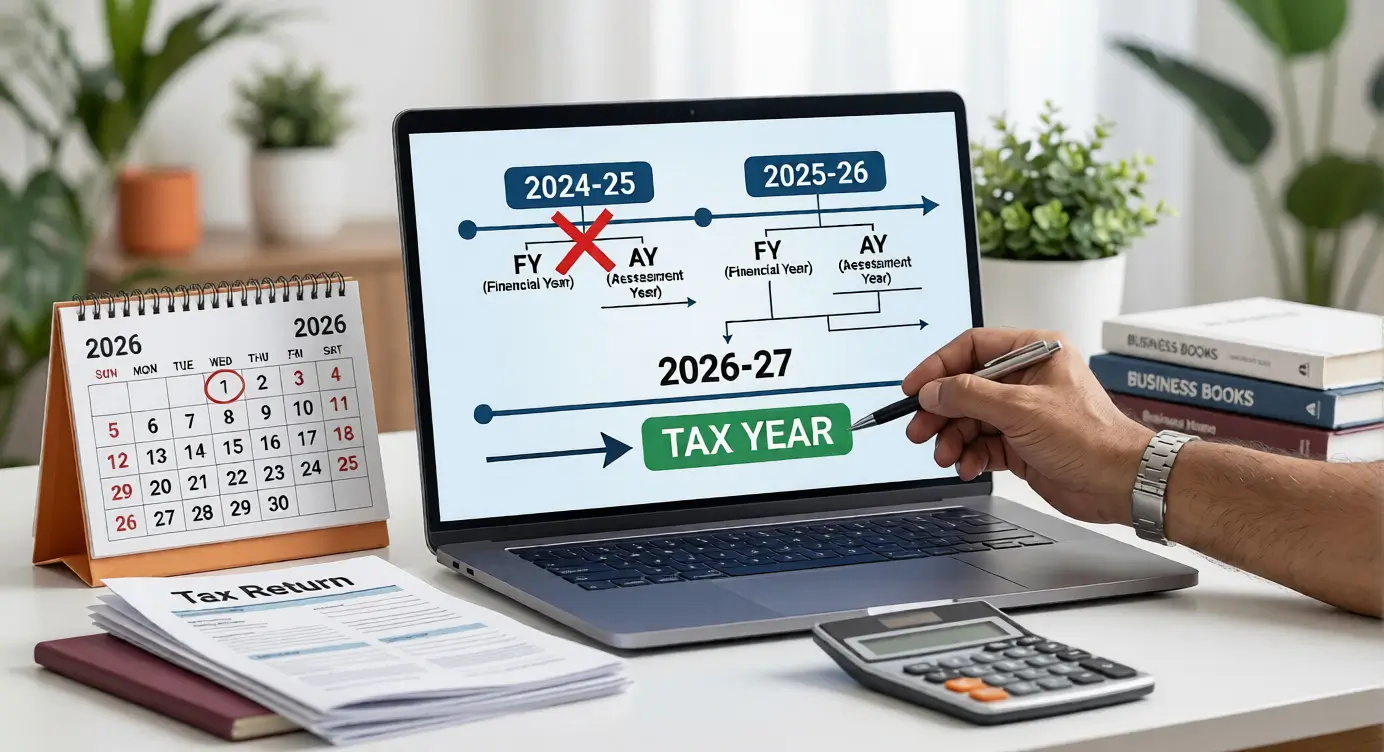
If you have ever filed an income tax return in India. You know the headache of matching dates. We have lived with two confusing terms for decades. We earn money in a “Financial Year,” but we report it in an “Assessment Year.” This gap has always been a source of stress for the common man. Many people end up choosing the wrong year on the tax portal or while paying advance tax. But the government has finally listened to our complaints. With the rollout of the New Income Tax Act 2025 the old system is going away. Starting from April 1 2026 we will use one simple term called the “Tax Year.”
This change will make life easier for taxpayers. The goal is to remove the unnecessary technical words that make tax feel like a math exam. Consider the way we monitor our monthly pay or our sales at the shop. We consult the calendar, and we are fully aware of what we earned. Why should taxes be any different? The concept of the new Tax Year makes your earning period identical to your reporting period. This implies that there would be reduced confusion and errors made during the filing season. It is a rational shift to the philosophy of the One Year One Tax, which everyone can comprehend.
Table of Contents
The confusion of the old system
We must look at the mess we are leaving behind to understand why the Tax Year is a blessing. In the old 1961 Act the Financial Year (FY) was the period when you earned your income. For example, if you worked from April 2024 to March 2025 that was your FY 2024-25. But the Income Tax Department did not want your return then. The Tax Department requests you to file it in the Assessment Year (AY) 2025-26. This meant the “Assessment” happened in the year following the “Earning.”
This delay of one year caused enormous confusion to both salaried employees and small business owners. Individuals frequently read their Form 16 and read one year, whereas the tax portal requests a different year. In case you made a mistake and chose the wrong year, your payment would not be reflected in your account. Then you had to make a rectification request, which took months to be processed. The system of the two years was a relic of the past in which all was done on paper. In the modern digital era, information is updated as soon as possible.
Enter the Tax Year: Simple and direct
The New Income Tax Act 2025 introduces the “Tax Year” to replace both FY and AY. There is no more looking ahead or looking back from April 2026 onwards. The year you earn the money is the same year you call your Tax Year. If you earn an income between April 1 2026 and March 31 2027 you will simply refer to it as Tax Year 2026-27. There is no hidden second year to worry about when you go to the government website.
This change also changes how the tax portal will look. You will see a single timeline instead of a dropdown menu with overlapping years. This is great news for the millions of Indians who are now filing their own taxes without a CA. The chances of error drop to zero when the terminology matches your bank statement. You don’t need a degree in finance to figure out which box to click. The Tax Year concept respects the user’s time and intelligence by keeping things straightforward.
How the transition will work for you
You must be thinking about what will happen during the switch. The shift occurs on April 1, 2026. We have to follow the old method FY and AY rules until March 31, 2026. The income received during the present time will still be reported using the old naming system. But, from April 2026, when the new law will be implemented. The tax department has already begun replacing its systems to accommodate this colossal change in nomenclature.
The government will likely provide a “Bridge Year” guide for a smooth transition. This will help people who have ongoing tax cases or pending refunds from previous years. The old records will stay as they are but all new entries will follow the Tax Year format. It is like shifting from an old house to a new one. You keep your old memories in the old format but you start your new life with a fresh layout. This is the most significant administrative reform in Indian tax history since independence.
Old System vs. New Tax Year System
| Feature | Old System (Pre-April 2026) | New System (Post-April 2026) |
| Earning Period | Financial Year (FY) | Tax Year |
| Filing Period | Assessment Year (AY) | Tax Year (Reporting Phase) |
| Naming Example | Earn in FY 24-25 / File in AY 25-26 | Earn and Report in Tax Year 26-27 |
| Logic | Lag-based (Two different years) | Real-time (Single year) |
| User Ease | Low (Very confusing for laymen) | High (Intuitive and simple) |
Why does this help with your financial planning
You can plan your budget much better when the tax system is simple. People used to wait for the “Assessment Year” to realize how much tax they actually owed earlier. The calculation becomes a part of your daily life under the Tax Year system. You can easily match your monthly TDS (Tax Deducted at Source) with your annual tax liability, since the name is the same. This helps in maintaining a better cash flow throughout the year.
- Clearer TDS Tracking: You can match your monthly salary slips with your tax liability without confusing the years in your head.
- Better Investment Timing: Since the tax year is clear you know exactly when to make your ELSS or PPF investments to get the benefit for that specific period.
- Simplified Bank Records: Your bank interests and fixed deposit gains will now align perfectly with the tax year mentioned on the portal.
- Easier Loan Applications: Banks usually ask for 3 years of ITR. With a unified tax year they can verify your income faster without matching FY and AY.
- No More Penalty Mistakes: Most penalties happen because people pay advance tax for the wrong year but this risk is gone now.
Tracking your TDS becomes much easier when the name on your salary slip matches the name on the tax portal. You won’t have to wonder if your March salary belongs to this year or next year. You can be sure that a deposit made on March 30 fits into the current tax year for investments like PPF. Banks also struggle with matching your interest certificates to your filed returns because of the FY/AY gap. A single tax year means your bank statement and your tax return will speak the same language. This also speeds up loan processing as the verification becomes a one-step process. You save money on penalties because you won’t accidentally pay tax for the “Assessment Year” when you meant the “Financial Year.”
The impact on small businesses
If you run a small kirana store or a freelance business this change is a lifesaver. Small businesses often struggle with “Book Closure” every March. They have to manage their accounts for the financial year and then wait months for the assessment year to file. The new Tax Year allows them to close their books and report their income almost simultaneously. This reduces the accounting fees you pay because the workload for your accountant becomes more streamlined.
You just look at your total turnover for the Tax Year and pay a fixed percentage as tax. There is no more mental gymnastics involved in explaining your income to a bank or a government officer. The simplicity of the Tax Year will encourage more small businesses to enter the formal economy. When the rules are easy to follow people are more willing to pay their fair share.
Actions you should take now
Even though the Tax Year officially starts in April 2026 you should prepare your mindset now. Start by organizing your digital folders. Instead of labeling folders as “FY 24-25” or “AY 25-26” start using a simple “Tax 2025” or “Tax 2026” format. This will help you get used to the single-year logic. Check your previous tax filings to ensure there are no pending mismatches also. Clearing the old mess now will make the transition to the new system much smoother.
If you are an employer start talking to your payroll team. They will need to update their software to reflect the Tax Year terminology. This will prevent your employees from getting confused when they receive their tax projections in 2026. If you are proactive, it shows that you are a responsible citizen and a smart manager of your finances. The transition is inevitable so it is better to be ahead of the curve than catch up at the last minute.
Conclusion
The change to the Tax Year is not just a change in name. That is an indication that the Indian tax regime is modernizing and customer-friendly. By executing the bewildering Financial Year and Assessment Year pair, the government is making tax filing easy for all. We are heading to the times when you do not necessarily have to be a genius in math to work with your own money. With an open mind, accept this change as we enter April 2026. It will save time and relieve the burden of compliance. It is important to remember that a simple system is just a system. By ensuring that taxation is made comprehensible, the New Income Tax Act 2025 is now preparing us to a brighter and more transparent future. Be watchful and keep your books in order as we integrate into this great new era of Indian taxation.
