
Tax season in India usually brings a bit of a headache for most of us. We always think of income tax as something we deal with only in July when filing our returns. But as long as you are earning a good living, either by a salary with some side jobs, a business, or even being a professional consultant. The government expects you to pay as you earn. This is exactly what we call an advance tax payment.
Instead of waiting until the end of the financial year to clear your dues in one massive chunk, the Income Tax Department requires you to pay in installments. It might sound like extra work, but honestly, once you get the hang of the advance tax payment online process, it actually helps you manage your cash flow much better. It prevents that “tax shock” in March and keeps you away from those pesky interest penalties under sections 234B and 234C.
Table of Contents
Understanding the Basics: What is an Advance Tax Payment?
Before we go into how to make a payment of tax, it is important to know it in simple terms. Think of it like a prepaid SIM card or a monthly utility bill. You are practically paying your income tax to the government within the same year you are making the income. If your total tax liability for the year (after deducting TDS) is ₹10,000 or more, then you are included in the bracket of persons required to make advance tax payment.
This applies to all, whether they are paid a salary and have rental income or capital gains, freelancers, businessmen, or professionals. The only significant exemption is in the case of the elderly (60 years and above) having no revenue from a business or occupation. For the rest of us, staying on top of these payments is a sign of good financial hygiene. It’s not just about following the law, but it is also about not paying the 1% monthly interest penalty that becomes effective in case of missing such deadlines.
Advance tax simply means paying your income tax before the financial year ends. Instead of paying one large tax amount at the time of filing your return, you pay small portions throughout the year.
It is comparable to an installment system of income tax. The government receives tax revenue on a regular basis, and taxpayers are not required to pay a huge tax amount in one instance only.
Who Needs to Make Advance Tax Payment?
Everyone does not need to pay advance tax. The overwhelming majority of salaried employees have nothing to worry about it as his/her employer pays off TDS right off their salary.
In India, there are different categories of taxpayers who are required to pay advance tax.
• Freelancers and consultants
Independent workers are also likely to get remuneration without tax deductions. They have to compute their earnings and make advanced tax payments by themselves.
• Business owners and self-employed professionals
Advance tax is usually paid by small business owners, doctors, lawyers, and other professionals whose incomes are not subjected to full coverage by TDS.
• Individuals earning income from investments or rent
If someone earns income from capital gains, property rent, or interest without sufficient TDS deduction, advance tax may apply.
• Companies and partnership firms
Businesses usually estimate their yearly income and make advance tax payments throughout the year.
Each of these taxpayers should estimate their annual income and calculate the tax liability accordingly.
Keeping Track of the Advance Tax Payment Due Date
Timing is everything when it comes to taxes. You cannot just pay the whole amount on March 31st and call it a day. The government has set specific milestones throughout the financial year. Missing these milestones is what usually leads to interest charges, even if you eventually pay the full tax amount later.
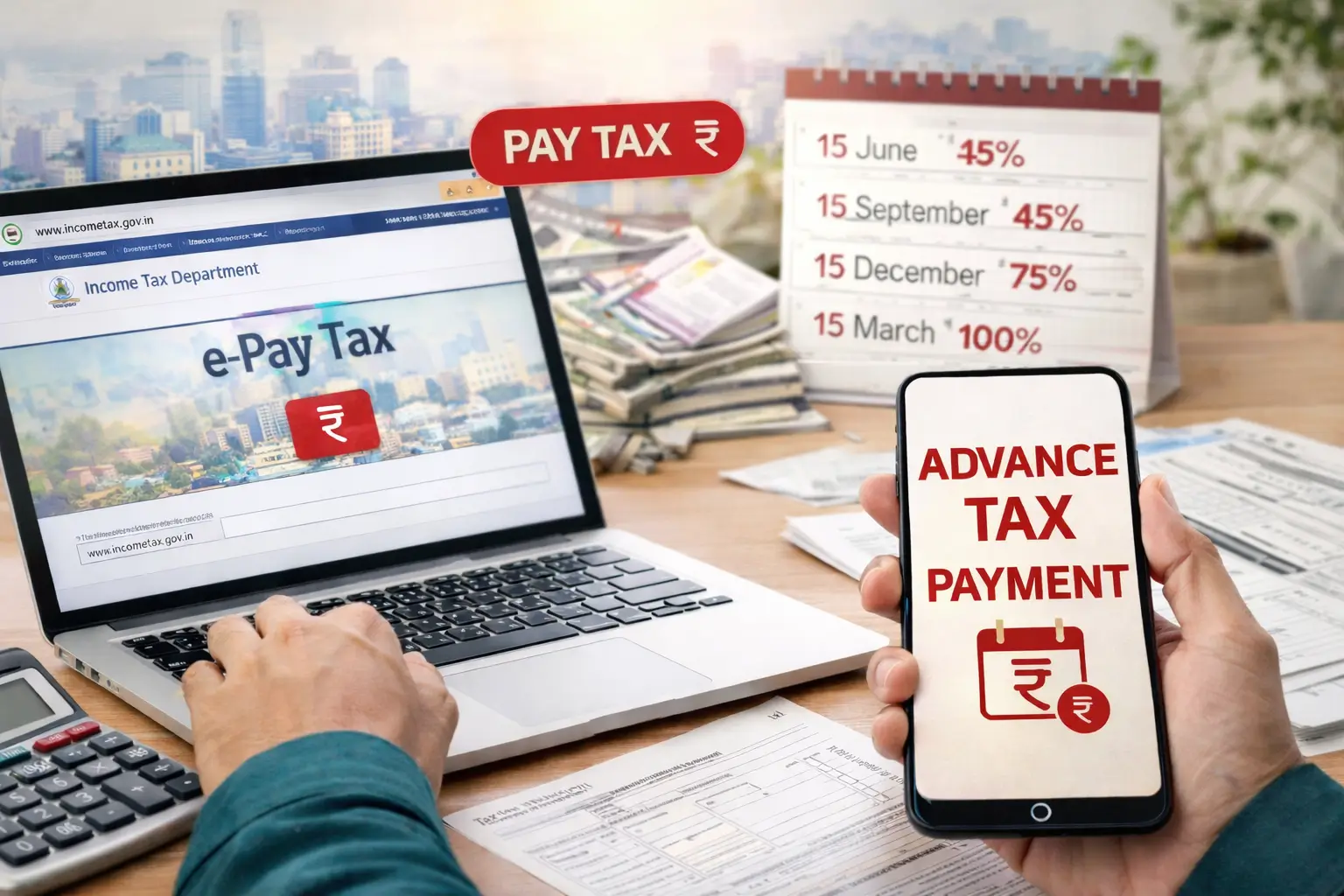
To the majority of individual taxpayers and corporations, the advance tax payment due date is quarterly. You will be required to pay 15 percent of your estimated tax by June 15 th, 75 percent by December 15 th, and 100 percent by March 15 th. How easy it is for those who have already chosen the presumptive taxation scheme (such as small businessmen or professionals under Section 44AD/44ADA), since you only have to make one instalment (the entire 100 per cent) before 15th March.
| Installment Due Date | Cumulative Amount to be Paid |
| On or before 15th June | 15% of the total estimated tax liability |
| On or before 15th September | 45% of the total estimated tax liability |
| On or before 15th December | 75% of the total estimated tax liability |
| On or before 15th March | 100% of the total estimated tax liability |
If taxpayers miss these deadlines, the Income Tax Department may charge interest under applicable tax rules.
Paying advance tax on time helps avoid unnecessary penalties and keeps tax compliance smooth.
Benefits of Paying Advance Tax on Time
It is not that bad to be a diligent taxpayer. It creates a spotless financial profile, which is invaluably useful when one is seeking home or car loans, or even foreign travel visas. Banks use your ITR and payment of tax history to determine your financial stability. Regular payment of advance income tax demonstrates that you are a good earner who has regular flow of income.
Advance tax is not taken seriously by many taxpayers as it has some benefits.
• Avoids interest and penalties
If you pay your taxes according to the scheduled due dates, you are free from interest charges that apply to delayed payments.
• Reduces financial pressure
Paying tax in installments spreads the financial burden across the year instead of facing one large payment at the end.
• Improves financial discipline
Advance tax encourages taxpayers to track income and manage finances more carefully.
• Smooth income tax filing process
When taxes are already paid in advance, filing the final income tax return becomes easier.
These benefits make advance tax payment an important financial practice for professionals and business owners.
How to Calculate Your Advance Tax Liability
You may ask yourself how you can be taxed using money that you have not earned yet in an entire year. Here is where estimation is involved. You also have to consider your current income, estimate the income you will make until the end of this year, and find out the tax as per the prevailing slab rates thereof.
It is normally done in three straightforward steps.
- Calculate total income from all sources, such as business, freelance work, rental income, or investments.
- Subtract deductions available under sections like 80C, 80D, and other applicable deductions.
- Apply the correct income tax slab to calculate the total tax liability for the financial year.
The most crucial step is to deduct the TDS (Tax Deducted at Source), which has already been deducted from your salary or interest. When the balance amount is more than 10,000, you need to proceed with the advance income tax payment online.
Tax advisors/ accountants are also consulted by many professionals to make the calculations precise.
How to Make Advance Tax Payment Online
Days long gone when you had to stand in long queues in the bank with a paper challan are the things of the past. Processing the advance tax payment online system has become very smooth via the e-filing portal. It can be done either at the comfort of your home or office via net banking or via debit card, or through UPI in certain instances.
It is easy to make your advance income tax payment online, provided that you have your bank details and PAN along with you.
Follow these steps to ensure your payment is recorded correctly:
- Visit the e-Filing Portal: Go to the official Income Tax Department website and locate the ‘e-Pay Tax’ section on the home page. This portal is the primary gateway for all advance tax payment activities and does not always require you to log in to your account for quick payments.
- Verification via PAN and OTP: Enter your Permanent Account Number (PAN) and confirm it by typing it again. You will then need to provide a valid Indian mobile number to receive a one-time password (OTP), which serves as a security layer to verify the person making the advance income tax payment online.
- Select the Correct Assessment Year: Choose the ‘Assessment Year’ (AY) carefully from the dropdown menu. For the current financial year (FY 2025-26), your Assessment Year will be 2026-27; selecting the wrong year is a common mistake that can lead to complicated rectification requests later.
- Choose the Tax Type: Under the available payment categories, look for ‘Advance Tax’ which is usually coded as (100). Selecting this specific head ensures the government identifies your contribution as a timely advance income tax payment rather than a penalty or self-assessment tax.
- Enter Amount and Payment Method: Input the breakdown of your tax (Basic Tax, Surcharge, Cess) and choose your preferred mode of payment, such as Net Banking, Debit Card, or the ‘Payment Gateway’ for UPI and Credit Card options. Once the transaction is successful, always save the generated challan which contains your BSR code and Challan Serial Number for future ITR filing.
Common Mistakes to Avoid While Paying Advance Tax
Even experienced taxpayers sometimes make small mistakes while making advance tax payment online.
One of the most common mistakes I see is selecting the wrong Assessment Year (AY). Always remember that the AY is the year following the Financial Year (FY) in which you earned the money. If you pay under the wrong AY, it becomes a nightmare to get it corrected or adjusted later. If income turns out to be higher than expected, the taxpayer may need to pay additional tax along with interest.
Another error is misclassifying the type of tax. Make sure you select ‘Advance Tax’ and not ‘Self-Assessment Tax.’ Self-assessment tax is what you pay after the financial year has ended but before filing your return. If you are paying within the financial year (before March 31st), it is almost always advance tax. Lastly, double-check your PAN. Even a single-digit error can credit your hard-earned money to someone else’s account, and getting a refund for that is a long, tedious process.
Another issue occurs when taxpayers forget to include certain income sources such as interest from fixed deposits or short-term capital gains.
Carefully reviewing all details before submitting the payment helps avoid these problems.
Why You Should Never Skip Advance Tax
I have seen many people ignore advance tax because they find the calculation confusing. However, the cost of ignoring it is much higher than the effort of doing it. When you delay your advance tax payment, the interest starts compounding. Section 234C handles the interest for shortfalls in individual installments, while 234B kicks in if you haven’t paid at least 90% of your total tax by the end of the financial year.
If a taxpayer fails to make advance income tax payment despite having a tax liability above ₹10,000, the Income Tax Department may charge interest.
This interest is calculated under specific provisions of tax rules. The interest applies both for missing installments and for underpayment of tax.
In addition, delaying tax payments can also affect financial planning and create extra stress during the income tax return filing season.
Therefore, paying advance tax on time is always the safer and smarter approach.
Practical Tips for Managing Advance Tax Payments
Managing advance tax becomes easier when taxpayers follow a few simple habits.
Tracking income regularly during the year helps estimate tax liability accurately. Many freelancers and business owners maintain monthly income records for this purpose.
Setting reminders for the four advance tax due dates also helps avoid late payments.
Some taxpayers also keep a separate savings account for tax payments. This ensures that funds are always available when the installment due date arrives.
These small steps make advance tax management much simpler.
How to Use the e-Pay Tax Feature Effectively
The e-filing portal has been significantly upgraded recently to make the advance tax payment online experience smoother. You no longer need to have a specific bank account; the “Payment Gateway” option allows you to use any bank’s credit card, debit card, or net banking.
- Check your Form 26AS regularly: This is your tax passbook. It shows all the TDS and advance tax already credited to your PAN. Checking this before making a payment ensures you aren’t overpaying.
- Keep a digital folder for challans: Every time you make an advance income tax payment online, save the PDF receipt immediately. Don’t rely on the portal to always have it ready for download later.
- Estimate conservatively but accurately: If you are unsure about your future income, it is better to pay a slightly higher advance tax. If you end up overpaying, you can always claim a refund with interest when you file your ITR.
- Use the Income Tax Calculator: The official portal provides a calculator that helps you estimate your liability. This takes the guesswork out of the process and helps you stay precise.
- Set reminders for due dates: Since the dates fall in the middle of the month (15th), they are easy to forget. Set a calendar alert for the 10th of June, September, December, and March to give yourself five days to arrange the funds.
Summary
Understanding advance tax payment online is important for freelancers, professionals, business owners, and investors in India. By breaking down your tax liability into smaller, quarterly payments, you are essentially protecting your future self from financial stress and legal hurdles.
By estimating income carefully, following the advance tax payment due dates, and completing advance income tax payment online, taxpayers can avoid interest penalties and manage their finances more effectively.
The online payment system has made the process simple and convenient. The process of advance tax payment online is now faster and more transparent than ever, leaving us with very few excuses to delay. Take control of your finances today, calculate your estimates, and make sure you meet the next advance tax payment due date with confidence.
