
If you handle transport of goods in India, you already know how important the E-Way Bill is. But one small field in the E-Way Bill form creates maximum confusion for the pin-to-pin distance.
Many business owners treat it casually. Some enter an approximate number. Some copy old values. Some use city distance instead of exact location distance. Later, when a vehicle gets stopped, or an E-Way Bill expires mid-transit, they realise the mistake.
So, let’s understand this properly in simple language, so you never face that situation in the future.
Table of Contents
What Is Pin to Pin Distance?
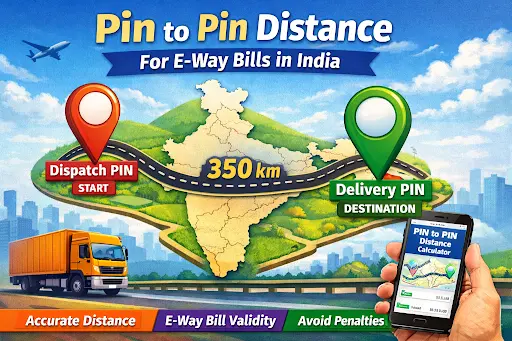
Pin to pin distance means the actual motorable road distance between the dispatch PIN code and the delivery PIN code.
In GST compliance, you must calculate the pin code to pin code distance instead of the general city distance. The E-Way Bill system uses this number to decide validity.
It does not calculate validity based on travel time. It calculates validity based on kilometres.
So if your pin to pin distance km entry is wrong, your validity period becomes wrong.
Why Pin to Pin Distance Is Important Under GST
According to the GST rules, the validity of the E-Way Bill is directly associated with distance slabs. The system shall require businesses to key in the correct pin to pin distance GST values.
In case you do not estimate distance properly, it is likely your E-Way Bill will run out, and goods will still be moving. When you assess irrationally, you will not be spared even when you are being inspected.
GST authorities compare the invoice address, transporter details, and the entered distance. If something does not match logically, scrutiny increases.
This is why understanding the GST pin to pin distance properly is not optional. It protects your movement and reduces compliance risk.
How E-Way Bill Validity Depends on Distance
The validity of an E-Way Bill increases in slabs based on kilometers. Even a small difference can shift your validity into the next bracket.
Below is a simplified reference table for general cargo:
| Distance Range (KM) | Validity Period |
| Up to 200 km | 1 Day |
| 201–400 km | 2 Days |
| 401–600 km | 3 Days |
| 601–800 km | 4 Days |
| Every additional 200 km | +1 Day |
If your pin code to pin code distance in km is 402 km, but you enter 398 km, your E-Way Bill validity becomes shorter than required.
That small difference can cause trouble during long-haul transport.
Pin Code to Pin Code Distance in Real Business Situations
For learning purposes, suppose you dispatch goods from an industrial area in Faridabad and send them to a warehouse in Jaipur. Many people check the city-to-city distance and assume it is around 280 km. But the actual distance pin to pin from your exact factory PIN to the delivery warehouse PIN may differ.
Warehouses usually sit on the city’s outskirts. Industrial clusters lie far from main centres. Highways may change routes.
This is why calculating pin to pin distance for an e-way bill based on exact postal codes matters.
How to Do a Proper Pin to Pin Distance Search
You are required to go through a disciplined procedure of a proper pin to pin distance search.
To begin with, verify the dispatching point. The use of the head office PIN by many businesses is a mistake to warehouse PIN.
Second, confirm the delivery address mentioned in the tax invoice. The PIN code must match exactly.
Third, calculate the road-based pin code to pin code distance using reliable mapping logic. Avoid straight-line or approximate calculations.
Fourth, enter the exact kilometer value in the E-Way Bill system.
This approach reduces compliance risk significantly.
What Is a Pin to Pin Distance Calculator?
A pin to pin distance calculator calculates road distance between two PIN codes using mapped road networks.
It converts postal codes into geographical points and then identifies feasible road routes. It does not rely on aerial distance.
Using a calculator improves accuracy in eway bill pin to pin distance entry. It also creates consistency in case of audit or departmental verification.
The expanding business will favour organised systems rather than manual suppositions.
Difference Between Pin to Pin Distance and City Distance
Many transport teams still rely on city-to-city distance. That approach creates confusion.
City distance gives a general idea. But GST compliance requires precision.
For example, dispatching from a warehouse in outer Delhi to a consignee in Navi Mumbai will not match the standard Delhi-Mumbai city distance. The exact e-way pin to pin distance depends on both postal locations.
When authorities check your documents, they do not accept vague explanations. They expect logical and consistent ewaybill pin to pin distance entries.
Common Mistakes That Lead to Problems
These are some mistakes I have witnessed in Indian logistics operations. Some companies use a registered office PIN instead of the actual dispatch location. Some enter rounded numbers like 300 km instead of the actual 287 km. Some reuse old values even when the delivery location changes. Some teams ignore route changes due to diversions.
These small habits distort pin to pin distance gst entries.
During inspection, officers may compare invoice details with the actual movement pattern. If the distance looks unrealistic, they may question it.
Accuracy always works in your favour.
Interstate vs Intrastate Movement
Many people think distance calculation matters only for interstate movement. That assumption is incorrect.
Even within one state, actual road routes may be longer than expected. Rural routes, highway diversions, and industrial zones increase real travel distance.
So, even for short state-level deliveries, calculate pin to pin distance km carefully.
Accurate GST pin-to-pin distance ensures your E-Way Bill remains valid until delivery is completed.
What Happens If Distance Is Entered Incorrectly?
If you enter a lower distance than the actual, your E-Way Bill may expire mid-transit. In that case, the vehicle may face detention until the issue is resolved.
If you enter an inflated distance without justification, authorities may question your calculation method.
Both situations create unnecessary stress.
Correct pin code to pin code distance in km entry prevents these issues.
Practical Compliance Advice for Indian Businesses
It is always important to check the physical location where the dispatch is made before entering the E-Way Bill. Do not assume based on memory.
Cross-check the invoice address and PIN code before entry. Many clerical errors happen at this stage.
Maintain internal records of calculated pin to pin distance values. If any dispute arises, you can justify your entry.
Train your logistics staff to understand why an accurate pin to pin distance E-way bill matters. When teams understand consequences, they make fewer mistakes.
If a route changes significantly due to unforeseen conditions, review whether an E-Way Bill extension is required.
Small discipline prevents large penalties.
Impact on MSMEs and Growing Companies
For large enterprises, compliance teams handle these details. But for MSMEs, even one detained truck can disturb cash flow.
Accurate pin to pin distance search reduces operational uncertainty. It builds confidence in compliance.
As your business grows and shipment volume increases, automation becomes more important. Manual estimation does not scale efficiently.
Reliable pin to pin distance calculator systems support smoother growth.
The Future of Distance Compliance in India
India is steadily improving digital tracking and validation systems. Transport analytics and integration systems are becoming stronger.
This means authorities can verify the E-way pin to pin distance logic more easily than before.
Businesses that maintain structured and consistent GST pin to pin distance practices will operate smoothly in the long run.
Those who rely on guesswork may face increasing scrutiny.
Summary
Pin to pin distance may look like a simple kilometer entry in the E-Way Bill form. But it directly controls validity, affects transport timelines, and influences compliance safety.
Always compute the actual road based pin to pin distance between the correct dispatch and delivery PIN code. Avoid approximation. Maintain records. Train your team.
Precision secures your business in Indian GST logistics. With the right pin to pin distance, your E-Way Bill will remain valid, your goods will move without any issues, and you will be in compliance.
Small attention to detail today saves you from bigger problems tomorrow.
Read More: Things Should Know About New Startups in India
The content on Probusinessline.com is for informational purposes only and does not constitute professional advice. Please verify information independently and consult a qualified professional before making any decisions. We are not responsible for any actions taken based on this information.
