
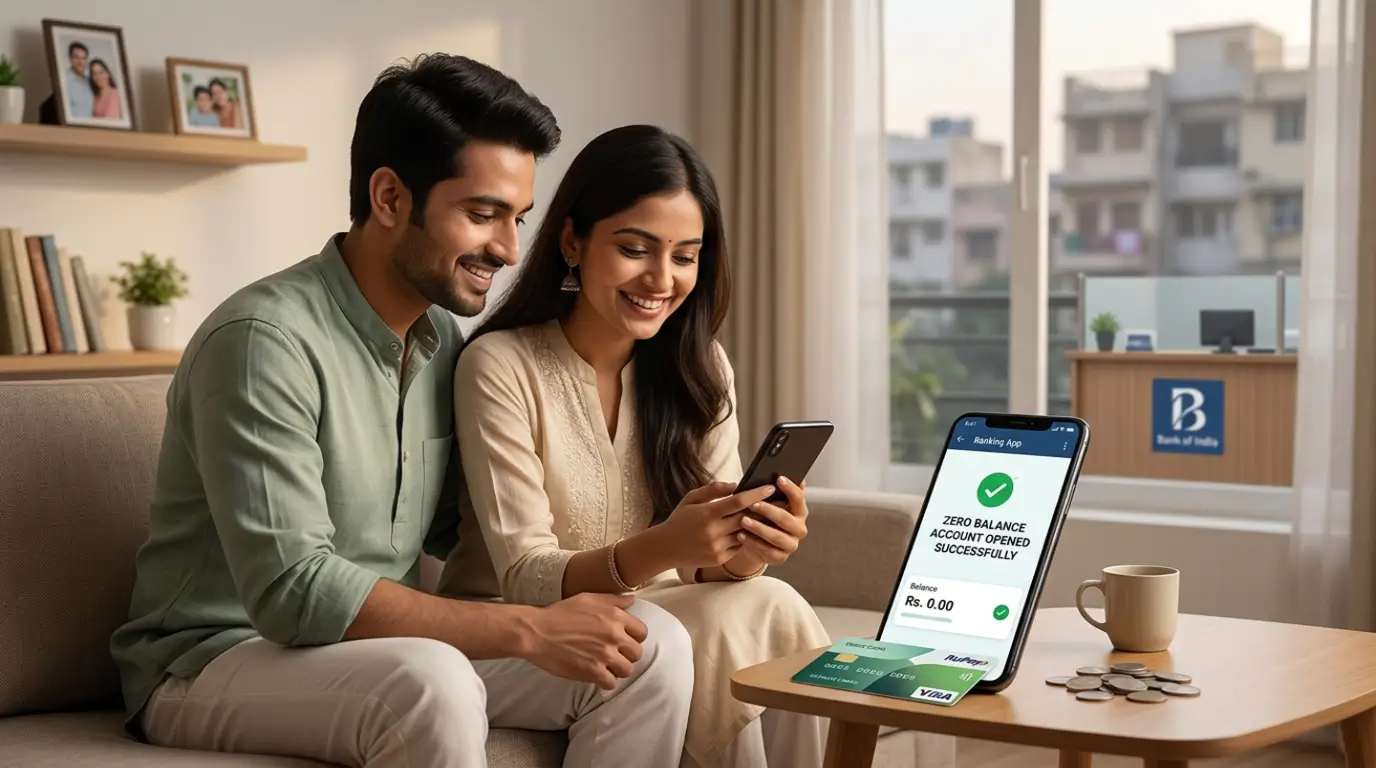
Money management in India has evolved considerably over the past few years. Previously, we were concerned with having a high minimum balance in our bank accounts. The bank would charge a substantial fine in case the balance decreased by even a few rupees. This was a huge problem for students or small earners and people just starting their careers. You do not have to deal with that stress anymore today. You can open a zero balance savings account and keep exactly as much or as little money as you want.
A zero balance savings account is exactly what it sounds like. You do not need to keep a single paisa in the account to keep it active. This is perfect if you want a secondary account for online shopping. It is also great if you are helping a domestic worker who wants to open their first bank account. It gives you the freedom to use your money without the fear of hidden charges. In this blog, I will explain how you can get this done quickly and easily from your home or by visiting a branch.
Table of Contents
What is a Zero Balance Savings Account Exactly?
In technical terms, these are often called Basic Savings Bank Deposit (BSBD) accounts. The Reserve Bank of India introduced these to make sure every Indian has access to banking services. These accounts offer almost all the features of a regular savings account. You get a debit card, you can use mobile banking, and you can even set up UPI for your daily tea or grocery payments. The only difference is the lack of a minimum balance requirement.
There are a few minor restrictions that you should know before applying for a zero-balance account. The banks charge you a maximum number of free withdrawals made in a month. Typically, you would receive a couple of free withdrawals through an ATM. Anything past that limit may cause a small fee or conversion of the account to a regular one by the bank. A couple of withdrawals are fine since we already do almost all our transactions with UPI.
Comparing Top Banks for Zero Balance Savings Account
Not all zero balance accounts are the same. Some banks offer better interest rates, while others have a better mobile app experience. Here is a quick comparison of the most popular options in India.
| Bank Name | Account Type | Interest Rate (Approx) | Top Feature |
| Kotak Mahindra | 811 Digital Account | 3.5% – 4% | Instant and paperless |
| HDFC Bank | BSBD Account | 3% – 3.5% | Trusted network |
| State Bank of India | Insta Plus Video KYC | 2.70% | High rural reach |
| AU Small Finance | Digital Savings | Up to 7.25% | Very high interest |
| Airtel Payments | Rewards Account | 2.5% | No physical branch needed |
Remark: Numbers in the table are not fixed and can vary based on government regulations and policies.
Why You Need Zero Balance Savings Account
From my years of looking at Indian personal finance I have noticed a pattern. People lose a lot of money in small maintenance fees without even realizing it. A zero balance account is a great way to bucket your money. You can keep your main salary in a regular account and move only your monthly spending money to a zero balance account. This way even if your spending account hits zero you don’t pay a penalty.
Another practical tip is for those who are wary of online fraud. Since you can keep a very low balance in these accounts they are safer to link with various shopping apps. If you only keep five thousand rupees in this account a hacker cannot steal your entire life savings from your main account. It acts as a safety shield for your primary finances.
The Step-by-Step Process to Open Your Zero Balance Savings Account
Step 1: Keep Your Paperwork Ready
It is impossible to open a bank account in India without proper identity and address documentation. In the case of a zero balance account, the process will be the smoothest when your mobile number is connected to your Aadhaar card. This enables the bank to check your information immediately by using an OTP. Your PAN card will also be required to file your taxes and to make sure that you will be in a position to hold larger sums of money in the event that you may need it in the future. With these digital copies on your phone, the online application will not take more than ten minutes.
Step 2: Choose the Digital Path for Speed
The majority of private banks, such as Kotak or Axis, offer an opportunity to create an account via the site or application. One just needs to enter their basic information and authenticate their Aadhaar through OTP. Once this is done, the bank will fix a Video KYC call. You will be captured on camera and requested by a bank officer to present your original PAN card. This is the most appropriate way since you do not need to wait in long queues at an overcrowded branch. It is secure, and you receive your account number in almost no time once the call is over.
Step 4: Visit the Branch for Traditional Accounts
In case you want to experience a public sector bank such as SBI or Punjab National Bank, then reaching a branch may be effortless. Request the officer to issue a Basic Savings Bank Deposit Account form in particular. There will be some staff members who will attempt to sell a regular account with a minimum balance since they have targets. Stick to your ground and demand the BSBD option. Carry two passport-size photographs and hard copies of your identity proof. It is an excellent option when you are residing in a town where the internet is unstable for video calls.
Step 4: Enable Debit Card and UPI
Once your account is open with the bank. The bank will send your Welcome Kit to your registered home address. This kit will include your RuPay/ Visa debit card and a chequebook if you ask. You need to visit an ATM and set a PIN or do it via the mobile application. Immediately connect this account to such apps as PhonePe or Google Pay. This will enable you to begin paying online and never again have to carry cash in your pocket or even be in fear that you have insufficient money.
Tips for New Zero Balance Savings Account Holders
After activation of your account, do not sit back there. Get a good financial habit and begin with it prudently. In case you are a student, use this account to claim your pocket money or internship allowances. Unless you are a parent who has one to explain to your child about saving. Minor life habits translate to major wealth.
- Look at Hidden Charges: The Schedule of Charges is always to be read on the bank’s site. Even the zero balance accounts can charge physical statements or SMS alerts. Switch off physical statements and use email ones to save money.
- Maintain updated KYC: Periodically (after every few years), the bank will require you to renew your papers. These messages should not be disregarded, or your account may be frozen. This update can nowadays usually be done via the mobile app.
- Use the Nominee Feature: Do not open a bank account without a nominee. This will make sure that your family can get the money at ease in case of any unfortunate circumstance. It takes just one minute to add a name and a relationship.
Knowing the effect of the Monthly Budget
We will consider a real-life situation of how much money you save by moving away from a traditional account. Suppose a regular account requires a 10,000 rupee minimum balance. If you fall below that, the average penalty is around 400 rupees per month.
| Penalty Item | Regular Account | Zero Balance Account |
| Monthly Fine | ₹400 | ₹0 |
| Annual Loss | ₹4,800 | ₹0 |
| 5-Year Impact | ₹24,000 | ₹0 |
Remark: Numbers in the table are not fixed and can vary based on government regulations and policies.
Over a year, that is 4,800 rupees gone for no reason. In five years, you lose 24,000 rupees. By switching to a zero balance account, you keep that money in your pocket. You can invest that saved money in a Mutual Fund SIP or a Fixed Deposit and watch it grow instead of giving it to the bank as a fine.
Conclusion
It has become one of the smarter financial moves that you can make right now by depositing money into a zero-balance savings account in India. It eliminates the pressures of keeping a limited balance in everyday life. It is now user- friendly to use the paperless digital path or go to your local branch, but the process is made user-friendly to all. You can get a jump start on your banking career without any hurdles as long as you select the appropriate bank and have your documentation in hand. Begin now and make your personal decisions on how to be free of finances without fear of punishment.
Read More: Simple Guide to Using a Pension Calculator in India
