
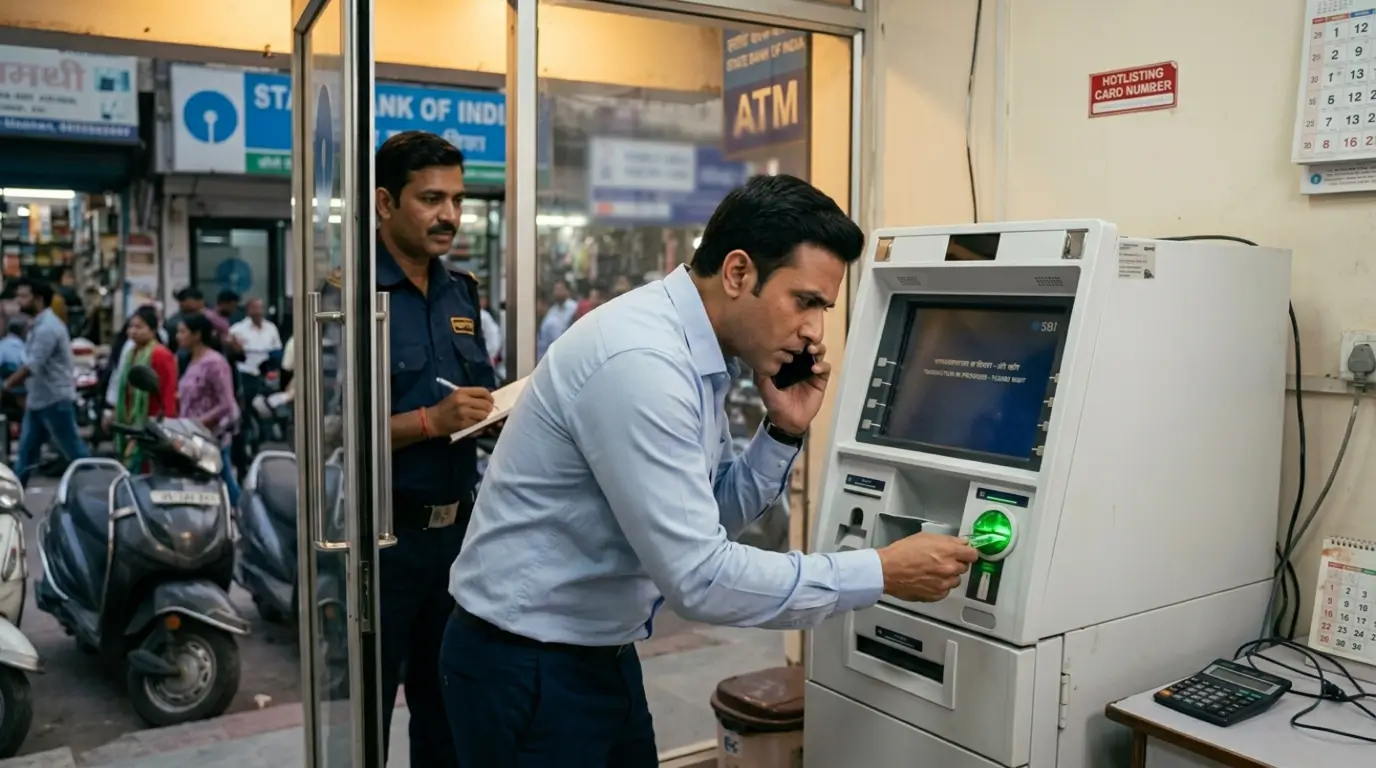
Suppose you are standing in an ATM booth in the middle of a busy market. And you insert your debit card, enter your PIN, and wait for the cash. The machine makes a strange noise, and the screen goes blank instead of showing money. You wait for your card to come out, but nothing happens. The machine has swallowed your card. This could be a nightmare situation for anyone, especially if you have an urgent payment to make.
It may make you suddenly rush with panic and begin pressing the buttons on the machine. You may even consider attempting to extract it using a thin object. Please do not do any of these things. Modern ATMs are designed to retain cards for security reasons. By keeping your head calm and following the correct procedure, it is not that difficult to get your money back and obtain a new card. This blog will make you understand why this occurred and precisely how to deal with the situation.
Table of Contents
Why Do ATMs Swallow Debit Card?
An ATM may hold your debit card for several reasons. The most common reason is entering the wrong PIN three times in a row. The machine assumes someone else is trying to guess your code and takes the debit card to secure your account. In case your debit card has expired or it was blocked by the bank, the machine is programmed to hold it.
Another common aspect in India is technical glitches. The machine may freeze with your card inside because of a sudden power cut or a connection break with the bank’s server. In some cases, the mechanical part that pushes the debit card back might be jammed or damaged. Whatever the reason, your priority is to ensure that no one else can use that debit card once you leave the booth.
Quick Comparison: On-Site vs Off-Site ATMs
The actions that you can do might vary depending on the location of the ATM. Not every booth is handled in a similar manner.
| Feature | ATM Inside Bank Branch | Standalone (Market) ATM |
| Immediate Help | You can talk to the branch manager | No staff available nearby |
| Retrieval Chance | Staff might be able to return it | Machine is opened by a third party |
| Wait Time | Usually faster resolution | Can take 7 to 10 working days |
| Security Risk | Lower due to bank guards | Higher if in a lonely area |
Immediate Actions You Must Take
Waiting a minimum of five minutes will ensure that the machine does not reboot and print the card out abruptly. Look at the screen to see whether there are any errors or directions. In case there is a security guard around, inform them, but do not provide them with your PIN and any personal information. It is only their role to record the complaint and not to repair the machine.
The next step would be to find the customer care number of the bank. The majority of ATMs have a sticker bearing a 24/7 toll-free number. Call them right now when you are at the booth. Provide them with the precise position of the ATM and the time of the incident. Ask them to hot-list or block your debit card number. This is the sole method that can ensure that you keep your money safe, even in case the debit card is withdrawn later.
Necessary Procedures to Protect Your Bank Account
- Lock Your Card Through Mobile Banking: A majority of Indian banks, such as SBI or ICICI, have wonderful mobile apps. When you are on an active internet connection on your phone, log in and locate the card management section. With a single tap, you can block your debit card. It is significantly quicker than taking ten minutes to wait for a customer care call. You can also block the card via the app, and you get a digital confirmation number, which will be very handy with regard to future complaints.
- Report to the Bank Branch Manager: If the ATM is attached to a bank branch, walk inside and explain the situation. They will require you to provide a written application and a copy of your ID proof. In certain instances where the bank staff are in charge of the ATM, they would give you the card back once they are satisfied with your identity. Many banks fill cash and machinery through third-party agencies. In case it is a third party, the branch will not open the machine on your behalf, and you will be required to apply to issue you a new debit card.
- Keep a Record of the Transaction: Take a picture of the ATM display in case there is an error message displayed. In case the machine printed a slip indicating that a transaction had failed, hold on to it. If no slip emerged, then record the ATM ID that is normally printed on the machine or on the top of the screen. Such information is vital when money is taken out of your pocket without receiving any cash. With the ATM ID, the bank will be able to trace the particular machine log to prove your claim when reconciling the statement.
- Apply for a Replacement Debit Card: After the card has been blocked, you will have to apply for another one to use your money. You will be able to request a replacement card either on the same mobile application or at your home branch. In India, most banks impose a nominal fee for a new debit card, the cost of which ranges between 200 and 500 rupees. The new card will be posted to your registered home address through speed post in a week. Your old card has been destroyed due to security issues, and therefore, the bank would not be expected to find your old debit card and send it back.
Resolving Money Deductions
The machine tends to swallow your card sometimes, and will even deduct money from your account, without giving you any cash back. This is a double blow. There is nothing to worry about since there are strict rules on the part of the RBI. The bank has to give you your money within a given duration of time. Otherwise, they must pay you a fine for each day. This is the reason why the ATM ID and the time of the incident are so crucial.
The bank tends to verify the “Extra Cash” at the end of the day in the machine. In case the machine contains extra cash against what is in their records, they will refund the money into your account automatically. Unless this is done in 48 hours, you should make a formal written complaint to the bank. Contact the local branch of the bank by using the “Grievance Redressal” part of the website of the bank.
Estimated Cost and Time Breakdown
Earning a new debit card and resolving the problem is not completely free of minor expenses and time delays.
| Service Item | Estimated Cost | Estimated Time |
| Blocking the Card | Free | Instant |
| New Card Fee | ₹200 – ₹500 | 7 Working Days |
| Money Reversal | Free | 5 – 7 Working Days |
| Penalty to Bank | ₹100 per day | After 5 days delay |
Remark: Numbers in the table are not fixed and can vary based on government regulations and policies
Expert Insights for Indian Card Holders
Many people have lost money due to the trust that they had in strangers at the ATM booth. Do not allow anyone to help you by typing in your PIN or attempting to repair the machine while your card is in it. Fraudsters also tend to put thin films in the card slot or glue so that it appears that the machine swallowed the card. And the moment you leave, they draw the debit card out and use it.
Never press the keypad with your hand when typing in your PIN. The machine may be malfunctioning, but it is your last resort to check your PIN. Should you be suspicious of foul play, then call the police helpline or the emergency number of the bank. It is always preferable to be on the safe side rather than lose all your hard-earned savings.
Good Practical Advice to Take Now
- Save Emergency Numbers: Add the helpline number of your bank that is available 24/7 on lost debit cards to your phone contacts. It will not have time to go searching during a crisis.
- Bring a Backup: You should never rely on a single ATM card when you are traveling. Have another debit card with another bank or a little emergency cash in the wallet.
- Cardless Withdrawal: Many modern ATMs in India have the facility of borrowing money by scanning a QR code on the display on your UPI app. This is far less risky because you do not even have to swipe your card.
- Check the Slot: Prior to inserting your card, give the card reader a slight pull. In case it is loose or seems to contain an additional element, walk away and use another machine.
Conclusion
The Indian banking system is strong and provides various levels of consumer protection to consumers. Remain composed and block your card as soon as you do this, so that you do not risk being stolen. Complete the proper procedure of complaining and requesting a replacement. Learn the lesson and start using safer options such as UPI. Your money is not lost in case you move fast and do not break the regulations. Be careful and keep your banking information confidential in order to have a financial life that is free of stress.
Read More: Stop Paying Penalties: How to Open a Zero Balance Savings Account in India
